



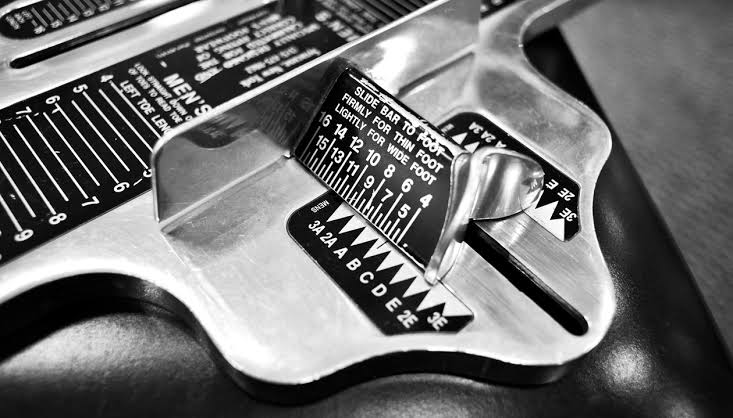
You’ve stepped on one a hundred times without ever learning its name. That flat metal plate at the shoe store — the one with the sliding bars and the numbers, the thing the salesperson nudged against your heel — is the Brannock Device. It’s nearly a century old, barely changed since the 1920s, and it’s still the single most trusted way to measure a human foot.
This is the full story: who invented it, how it works, and — most usefully — how to use it to nail your real size instead of guessing.
What is the Brannock Device?

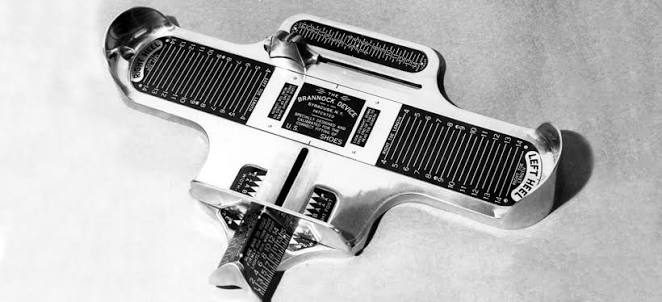
The Brannock Device is a foot-measuring instrument used to determine shoe size. It’s that hinged metal plate with a heel cup, a sliding pointer for length, and a bar that slides sideways for width.
Crucially, it doesn’t just measure how long your foot is. It captures three separate readings — length, arch length, and width — which together describe how a shoe actually needs to fit. That’s the whole reason it beat everything that came before it.
For roughly a hundred years it’s been the industry standard in shoe shops around the world. If you’ve ever been “properly” fitted for shoes, you’ve met one.
Who invented the Brannock Device?
The device is named after its inventor, Charles F. Brannock, who spent two years developing a better way to measure feet.
The tool to beat at the time was the wooden RITZ Stick — essentially a length-only measure, like a ruler with a heel stop. Brannock’s insight was that length alone doesn’t fit a shoe. So he built an instrument that added arch length and width, and patented his design in the mid-1920s (a first prototype in 1925, an improved version in 1927).
He then founded the Brannock Device Company to manufacture it, and ran the business himself right up until his death in 1992, at the age of 89. His invention was so central to American manufacturing history that the Smithsonian Institution holds nearly the complete records of its development.
After Brannock died, the company was sold in 1993 and manufacturing moved to a small factory in Liverpool, New York — where the devices are still made today, largely unchanged. (Syracuse loves it so much that in 2018 the city’s minor-league baseball team rebranded for one night as the “Syracuse Devices” in its honour. Genuinely.)
How the Brannock Device works
Every modern Brannock Device takes three measurements of each foot:
Foot length — the distance from your heel to the tip of your longest toe. This is the number most people think of as their “size.”
Arch length — the distance from your heel to the ball of your foot (technically the joint where your big toe bends). This is the measurement almost everyone ignores, and the one that matters most — more on that below.
Width — how wide your foot is across the ball, measured by sliding the side bar in until it meets the widest point.
The design detail people miss: the plate has both a left and a right heel cup. You measure one foot, then rotate the whole device 180 degrees to measure the other, because — and this trips up nearly everyone — your two feet are rarely identical.
How to measure your feet with a Brannock Device
Want to do it properly? Here’s the pro method, step by step:
- Stand up. Measure with your weight on your feet, not sitting down. Your foot spreads and lengthens under load, and you wear shoes standing.
- Heel first. Seat your heel firmly into the back cup so it’s snug against the curve.
- Read the length. Look at where your longest toe lands on the scale. Note the number.
- Set the width. Slide the side bar in until it just touches the widest part of your foot, and read the letter width.
- Find the arch. Slide the pointer so the arch marker sits at the ball of your foot — where your big-toe joint flexes. Read that number too.
- Take the bigger number. Compare your heel-to-toe length and your heel-to-ball (arch) length, and go with whichever is larger. This is the step that changes lives.
- Do both feet. Rotate the device and repeat. If your feet differ, fit to the larger one.
- Time it right. Feet swell during the day — measure in the afternoon or evening for a true reading.
The arch-length secret
Here’s the part almost nobody knows, and the reason the Brannock Device is genuinely clever: your shoe size is set by the longer of two measurements — heel-to-toe or heel-to-ball.
Why? Because a shoe flexes where your foot flexes — at the ball. If your foot is long from heel to ball but has shorter toes, your toe-length reading will under-size you, and the shoe will bend in the wrong place. Plenty of people have longer arch lengths than toe lengths and never realise it.
That’s why a good fitter always reads the arch scale and sizes to the bigger figure. If your shoes always feel a touch short or crease strangely across the toe, this is very likely why. It’s also exactly the kind of detail our sizing guide is built around.
Brannock sizes and widths, explained
The numbers and letters on the plate map to a specific system.
Length → numeric size. The scale is built on the old English barleycorn — a unit equal to one-third of an inch. One full shoe size equals a third of an inch; a half size is a sixth of an inch. It’s an ancient, slightly absurd unit, and the entire US/UK sizing world still runs on it.
Width → letter size. Widths run from AAAA (narrowest) to EEEE (widest), with B and D sitting in the middle as standard women’s and men’s widths respectively. This is the axis most people never get measured for — and bad width is often what “uncomfortable shoes” really means.
Men’s vs women’s. On the Brannock scale, women’s sizes are offset from men’s by one. It’s why the men’s-to-women’s conversion you use for sneakers exists in the first place.
Why it’s still here a century later
In an age of foot-scanning apps and 3D sizing, why is a piece of stamped metal from the 1920s still winning?
Because it’s fast, it’s accurate, it never needs charging, and it captures the three things that actually matter in about ten seconds. It’s also close to indestructible — the same unit can sit on a shop floor for decades.
It’s become a genuine design icon along the way: instantly recognisable, endlessly imitated, and quietly perfect at one job. Sometimes the best tool for a problem is simply the one that got it right the first time and never needed fixing.
Does it work for sneakers?
Mostly — with one big caveat. The Brannock Device gives you an accurate, brand-neutral baseline: your true length, arch and width. That’s the number to start from.
But sneaker sizing is not standardised. A Nike doesn’t fit like an adidas, a Samba runs long, an Air Force 1 runs large, and lots of ASICS runners run slightly long too. The Brannock reading tells you your foot; it can’t tell you a specific model’s quirks.
So use it as your foundation, then adjust per shoe. Know your true size, then read how each silhouette actually fits — which is exactly what our sizing guide and individual guides are for. Measure once, buy smart forever.
Brannock Device FAQ
What is a Brannock Device used for?
It measures your foot to determine shoe size, capturing three readings — length, arch length and width — so shoes can be fitted accurately rather than guessed.
Who invented the Brannock Device?
Charles F. Brannock, who spent two years developing it and patented his design in the mid-1920s, improving on the earlier wooden RITZ Stick.
How do you use a Brannock Device correctly?
Stand up, seat your heel in the cup, read the length, slide the bar for width, check the arch length, and size to the larger of your toe-length and arch-length readings. Measure both feet.
What do the letters on a Brannock Device mean?
They’re width sizes, running from AAAA (narrowest) to EEEE (widest), with B and D as standard women’s and men’s widths.
Is the Brannock Device still made?
Yes — it’s manufactured in Liverpool, New York, and remains the shoe industry’s standard measuring tool almost a century after it was invented.
Can I use a Brannock Device for sneaker sizing?
Absolutely, as a baseline. It gives your true foot measurements; just remember sneaker fit varies by brand and model, so adjust from there.