

In March 2021, a Brooklyn art collective dropped a single drop of human blood into a Nike and set the internet on fire. The Satan Shoes were limited to 666 pairs. They still triggered a scandal loud enough to pull in pastors, politicians, and — eventually — Nike’s lawyers.
Five years on, they remain the loudest sneaker release in history. They’re also, we’d argue, the most misread. This is the full story of the Satan Shoes: the blood, the backlash, the lawsuit, and why they mattered more than any “safe” collaboration that landed all year.
What are the Satan Shoes?
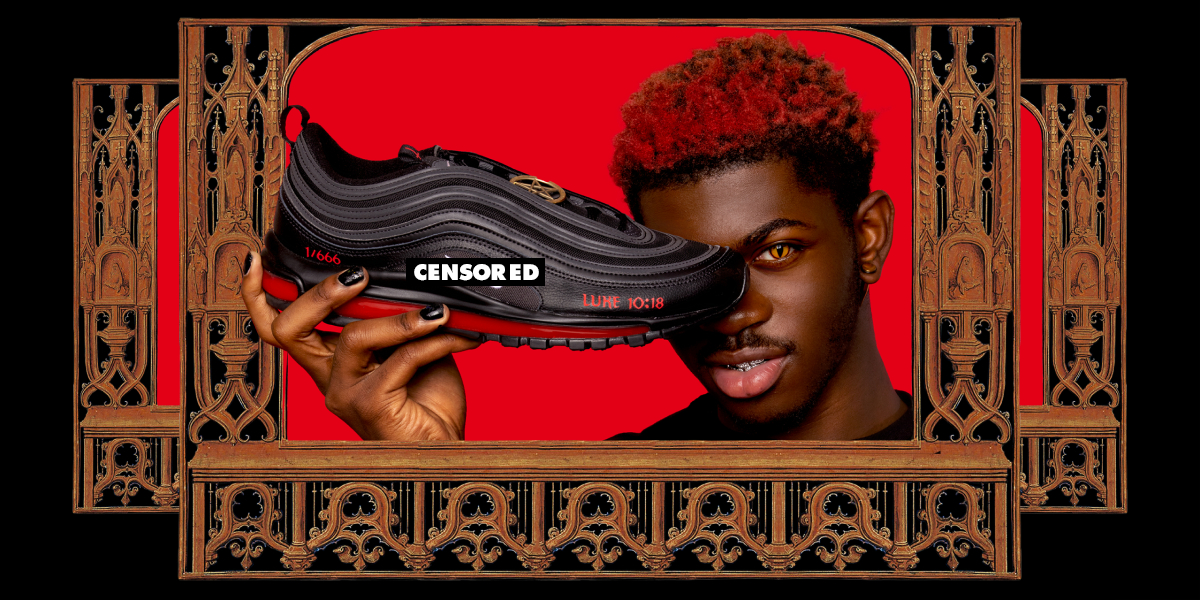
The Satan Shoes were a collaboration between the art collective MSCHF and rapper Lil Nas X, released in late March 2021 as MSCHF’s “Drop #43.”
They were customized versions of the Nike Air Max 97 — black and red, hell-themed, and completely unauthorized by Nike. Only 666 pairs were made, each priced at $1,018.
They sold out in about a minute.
That combination — a devil-worship aesthetic, a famous pop star, real human blood, and an untouchable Nike silhouette — was engineered to detonate. It did.
Inside the design: blood, a pentagram and scripture
Every detail of the Satan Shoes was loaded. This was not a graphic tee with a spooky logo; it was a fully-built object designed to provoke.
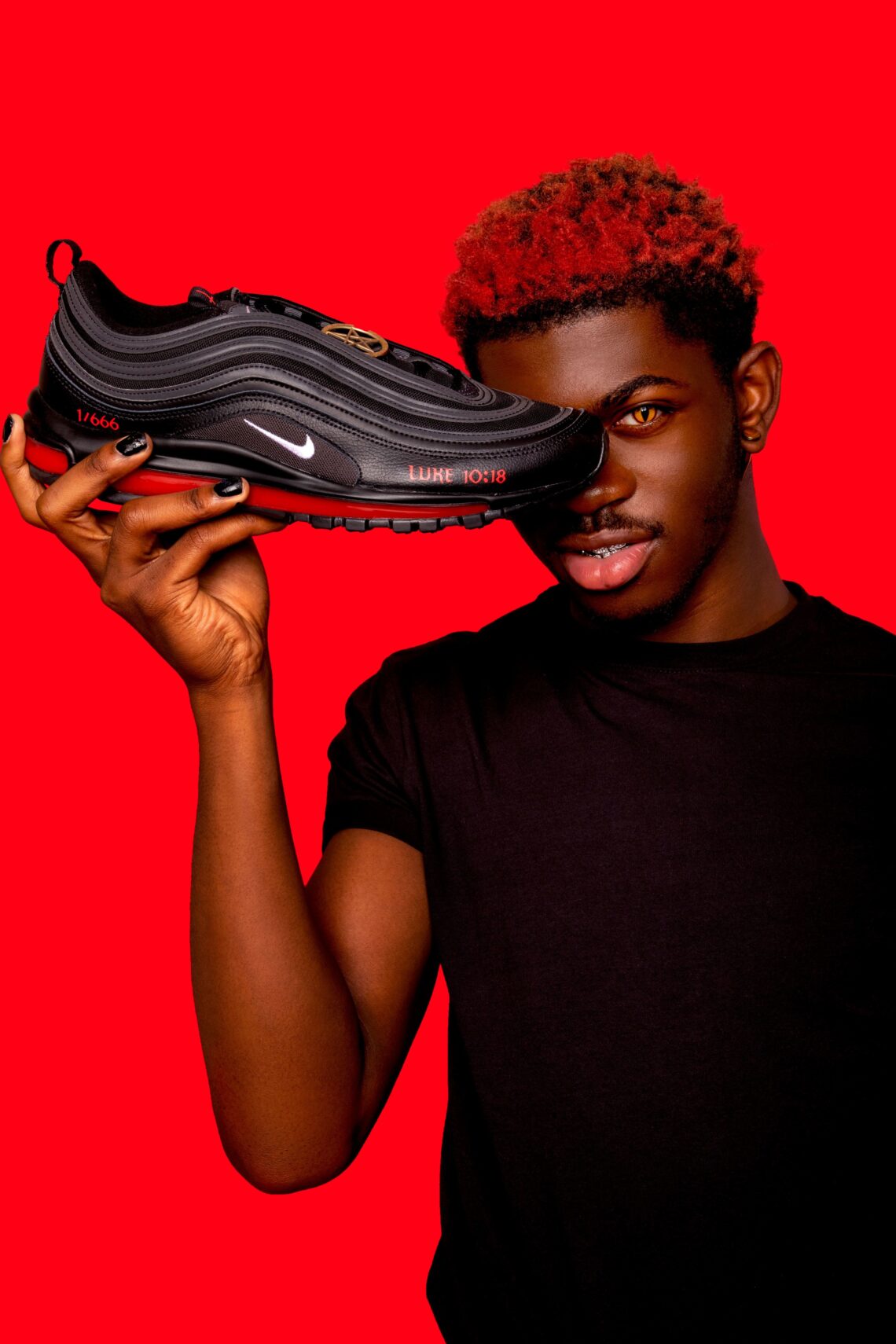
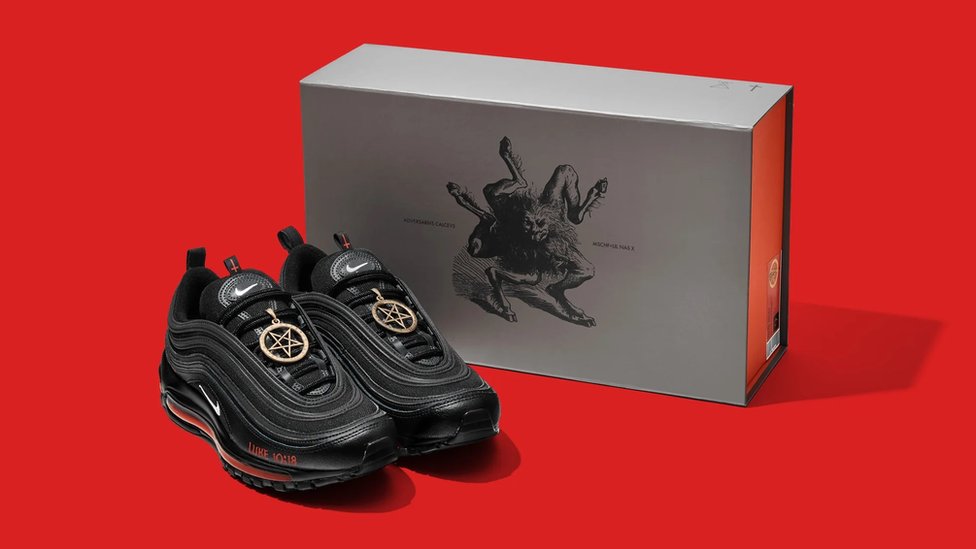
Each pair carried a bronze pentagram charm on the laces and an inverted cross, set on a black Air Max 97 with crushed-velvet and synthetic-leather trim.
The now-infamous part sat in the sole. MSCHF filled the air bubble with roughly 60cc of red ink and one drop of real human blood, donated by members of the MSCHF team. Yes — actual blood, in the shoe.
The price wasn’t random either. “$1,018” is a reference to Luke 10:18, the verse embroidered on the shoe: “I saw Satan fall like lightning from heaven.”
Even the packaging committed to the bit. The box featured Jan van Eyck’s 15th-century painting The Last Judgement, and the campaign leaned on Milton’s line from Paradise Lost: “better to reign in hell than to serve in heaven.” Nothing here was accidental.
The “Montero” masterplan
The Satan Shoes didn’t arrive in a vacuum. They dropped alongside Lil Nas X’s single and video “Montero (Call Me By Your Name)” — the one where he pole-dances down to hell and gives the devil a lap dance.
That context is the whole point, and it’s the part most of the outrage conveniently skipped.
Lil Nas X, an openly gay Black artist, had spent years being told by certain religious critics that he was going to hell. Montero — and the shoes that extended it — flipped that condemnation into a flex. If they were going to send him to hell, he’d redecorate the place.
For MSCHF, provocation is the medium. The collective had already done this once with 2019’s “Jesus Shoes,” Air Max 97s injected with holy water from the River Jordan. Nobody sued over holy water. The blood-and-brimstone sequel was always going to land differently — and MSCHF knew it. Read our wider culture and music coverage for how often the two now collide.
The Jesus Shoes: where it all started
To understand the outrage, you have to know the prototype. Two years earlier, in 2019, MSCHF released the “Jesus Shoes” — the same Air Max 97 silhouette, injected not with blood but with holy water sourced from the River Jordan.
That pair was priced around $1,425, blessed by a priest, and finished with a crucifix on the laces and frankincense in the tongue. It flipped for several times retail within days.
The reaction? Mild amusement. A few headlines, a lot of “only in Brooklyn” shrugs. Nobody sued. Nobody called their governor.
That contrast is the tell. The two shoes were mechanically identical — buy a Nike, inject a liquid, add religious hardware, sell a tiny numbered run. Only the theology changed. One got a chuckle; the other got a lawsuit and a moral panic.
MSCHF didn’t stumble into that. They engineered it. The Jesus Shoes were the control group; the devil pair was the experiment — a test of how much of a sneaker’s meaning is projected onto it, and how differently the culture polices heaven versus hell.
Satanic panic, 2021 edition
The reaction was instant and enormous. Religious leaders condemned the shoes. Conservative commentators framed them as proof of cultural collapse. A sitting US governor weighed in publicly. “Corrupting the youth” discourse trended for days.
Lil Nas X did not flinch — he trolled. He responded to the pile-on with a straight-faced “apology” video that abruptly cut to the Montero clip, and spent days needling critics online. Every angry quote-tweet was free advertising.
That’s the irony the outrage never grasped: the backlash was the marketing. This is the Streisand effect in Air Max form. The louder the condemnation, the more the Satan Shoes became the only sneaker anyone was talking about.
Nike vs. the devil: the lawsuit
Here’s the fact the headlines often buried: Nike had nothing to do with the Satan Shoes. It didn’t design them, didn’t sanction them, and didn’t want them.
So Nike sued. Within days of the release, the company filed a trademark-infringement suit against MSCHF, arguing that its swoosh on a “Satan”-branded shoe created a false association and damaged its brand. Nike claimed that even seasoned sneakerheads were confused about who actually made them.
A judge granted a temporary restraining order, briefly blocking further sales.
MSCHF’s defence was simple: the Satan Shoes were “individually-numbered works of art,” not mass-market product, and no reasonable buyer thought Nike had made them.
In early April 2021, the two sides settled. As a condition, MSCHF agreed to a voluntary recall — buying back the Satan Shoes (and the older Jesus Shoes) at their original $1,018 price to pull them out of circulation. The 666th pair, originally meant for a giveaway, never went out.
No court ever ruled on who was right. The settlement closed the case — and left the biggest question wide open.
Art or trademark violation?
This is where sneakerheads still split, and it’s the argument that actually matters.
MSCHF bought genuine, retail Nikes and modified them. Customizers alter branded shoes every single day; the whole bespoke scene runs on it. Under that logic, the Satan Shoes were just a very famous custom.
Nike’s counter is that a custom in your bedroom is one thing, but selling 666 pairs that pair the swoosh with “Satan,” a pentagram, and blood is another — that’s the brand being dragged into an association it never agreed to and can’t control.
Both arguments have teeth. And because the case settled rather than went to verdict, the line between “art” and “infringement” never got drawn. That ambiguity is exactly why the Satan Shoes still get taught, argued over, and cited whenever the next boundary-pushing collab lands.
Why the Satan Shoes still matter
Here’s our take, and it’s not the comfortable one: the Satan Shoes were the most important sneaker “collaboration” of the decade — precisely because they weren’t a collaboration at all. They were a hijack.
MSCHF proved that a sneaker’s meaning doesn’t live in the shoe. It lives in a logo somebody else owns. Put the swoosh next to the devil, and suddenly the most powerful brand on earth is dragged into a conversation it never chose. That’s not vandalism. That’s the whole thesis, worn on the foot.
They also exposed a quiet hypocrisy. The industry loves “edgy” and “disruptive” right up until something is actually disruptive — and then it reaches for the lawyers. A brand that markets rebellion sued to shut rebellion down.
And the real scandal? It was never the blood or the pentagram. It was how fast moral outrage got weaponised while the genuine craft and commentary underneath got ignored. Everyone argued about hell. Almost nobody talked about what the shoe was actually saying.
Five years later, the entire “drop culture” playbook — scarcity, provocation, sell-out-in-seconds, let the outrage do the ad spend — reads like it was photocopied from these 666 pairs. The Satan Shoes didn’t just break the internet. They wrote the manual.
Loud on purpose. The Satan Shoes were the loudest of all.
What a pair is worth now
Recalls are catnip for collectors. The moment MSCHF offered to buy pairs back, owning one became an act of defiance — and a bet.
Most buyers kept them. Why hand back a piece of internet history for a refund when the cultural value was only climbing?
On the rare occasion a pair surfaces on the secondary market today, it commands serious money — deep into five figures — as a genuine artefact rather than a wearable shoe. This was never a sneaker you’d lace up for the shops; it’s a gallery piece with a swoosh.
That’s the final twist. By trying to erase them, the lawsuit made the survivors rarer, more notorious, and more valuable. Scarcity plus infamy is the most potent formula in resale — and few objects have ever had more of both. It’s a dynamic we track constantly on the market desk, but nothing else quite compares.
Satan Shoes: History, Design & Legal Battle
What are the Satan Shoes?
The Satan Shoes are customized Nike Air Max 97s made by the art collective MSCHF with Lil Nas X, released in March 2021. Only 666 devil-themed pairs were produced.
How much did the Satan Shoes cost?
$1,018 a pair — a deliberate nod to the Bible verse Luke 10:18, “I saw Satan fall like lightning from heaven.”
How many Satan Shoes were made?
Exactly 666 pairs, and they sold out within about a minute.
Do the Satan Shoes really contain human blood?
Yes. Each sole’s air bubble held roughly 60cc of red ink plus one drop of real human blood donated by the MSCHF team.
Did Nike make the Satan Shoes?
No. Nike had no involvement and sued MSCHF for trademark infringement. The case settled with a voluntary recall.
Can you still buy the Satan Shoes?
Not officially — MSCHF recalled and bought pairs back at $1,018. Surviving pairs occasionally surface on the resale market at serious collector prices.
The Satan Shoes remain the ultimate proof that in sneakers, the most dangerous thing you can do isn’t add blood — it’s touch someone else’s logo. For more of the drops that made history, hit our culture desk.
Loud on purpose.