

Put your foot into a normal sneaker without using your hands and the heel folds flat under your sole. You end up walking on the back of your own shoe, which is how most people ruin a pair.
Skechers Slip-ins are built to solve exactly that, and the solution is one component: a moulded heel panel the company calls the Heel Pillow. It collapses as your foot enters, then springs back up and locks around the heel.
No laces to tie. No bending. No hands.
It sounds like a small thing. It has become one of the most commercially successful footwear ideas of the past decade, and Skechers has since pushed it across almost the entire range — walking, running, work, outdoor, kids.
Here is what the technology actually does, where it falls short, and what it costs in India — where, as of this week, the collection is running at 30 to 40% off.
What Skechers Slip-ins Actually Are
Slip-ins are not a single shoe. They are a technology applied across Skechers’ existing lines — GO WALK, GO RUN, Arch Fit, Sport, Outdoor and work styles all have hands-free versions.
Every one of them shares the same core parts.
| Component | What it does |
|---|---|
| Heel Pillow | Moulded heel panel that collapses on entry, springs back to hold the foot |
| Air-Cooled Memory Foam insole | Cushioning with perforations intended to reduce heat build-up |
| ULTRA GO midsole | Lightweight cushioned foam on most models |
| Stretch Fit upper | Engineered knit or mesh that flexes over the instep |
| Adjustable laces | Present on many models, but cosmetic — you set them once |
That last row is the one people misread. Laces on a Slip-in are not there to be tied daily. You adjust them once to set instep volume, then never touch them again. If you were planning to loosen them to get in, you have missed the point of the shoe.
Full specification is on Skechers’ own technologies page, and it is unusually clear for marketing material.
The 3D Energy, Specifically
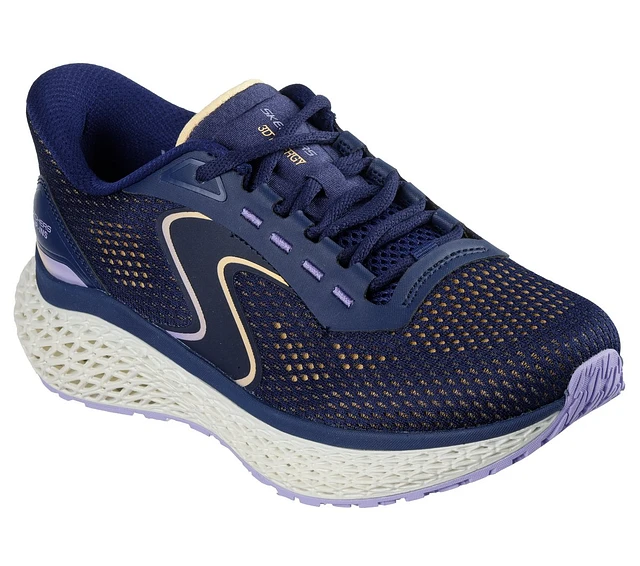
The model doing the rounds in US deal coverage this week is the 3D Energy, and it is worth separating from the rest of the line because it is not a typical Slip-in.
Alongside the Heel Pillow and Air-Cooled Memory Foam insole, it uses a 3D-printed lattice midsole — an open, geometric structure rather than a solid slab of foam. Uppers vary by colourway: engineered mesh on some, knit with synthetic overlays on others. All versions are vegan.
A lattice midsole is a genuinely different cushioning approach. Instead of compressing foam, you are compressing a structure, which can be tuned zone by zone and tends not to pack out the way foam does over a few hundred kilometres.
It is also newer, less proven at this price point, and thinner on long-term reviews than the rest of the Slip-ins range.
K&B Take: The Heel Pillow is the mature, proven part of this shoe. The lattice midsole is the interesting, less-tested part. Buy for the first, treat the second as a bonus.
What the Tech Gets Right
It genuinely works. This is not a gimmick that fails on contact. The heel panel is stiff enough to hold shape and soft enough to fold, and the mechanism does not need breaking in.
It solves a real accessibility problem. For anyone with limited mobility, back pain, arthritic hands, a late-stage pregnancy or simply a bad knee, bending to put on a shoe is a daily obstacle. A shoe you step into standing up is not a convenience feature for those buyers. It is the difference between independent and not.
It is fast. Airport security, a courier at the door, a temple visit where shoes come off and go back on repeatedly — India generates a lot of these moments, and Slip-ins handle them better than laces do.
The cushioning is legitimate. Skechers has been quietly good at comfort foam for years. Air-Cooled Memory Foam plus ULTRA GO is a soft, forgiving underfoot setup for walking and standing.
What Nobody Selling Them Mentions
Four honest caveats.
Heel lockdown is a compromise. A panel engineered to collapse under load is, by definition, less rigid than a proper heel counter. For walking, standing and casual wear it is fine. For running, lateral movement or anything requiring hard heel hold, it is a worse structure than a laced shoe. Skechers sells Slip-in running models; we would still lace up for actual running.
The panel is a wear part. It is the component doing repeated mechanical work every time you put the shoe on. On older pairs, a heel panel that has lost its spring is the most common failure, and it is not repairable.
You cannot dial in the fit day to day. Feet swell — in heat, on long days, on flights. A laced shoe absorbs that. A Slip-in has one fit, set at purchase.
Soft cushioning is not support. Memory foam feels excellent in a showroom and is not the same as structural arch support. If you need genuine support, look at Skechers’ Arch Fit line rather than assuming plushness will do the job.
Real India Prices
This is where most coverage of this shoe is useless to you. The US deal posts circulating this week point at Nordstrom Rack, which does not ship to India.
Here is the actual domestic picture. Skechers India’s Slip-ins collection currently lists:
| MRP | Current price | Discount |
|---|---|---|
| ₹11,999 | ₹7,199 | 40% |
| ₹11,999 | ₹8,399 | 30% |
| ₹8,499 | ₹5,099 | 40% |
| ₹6,999 | ₹4,199 | 40% |
So the working range is roughly ₹4,199 to ₹8,399 on discount, against MRPs of ₹6,999 to ₹11,999.
Prices verified at the start of September 2026. Skechers India runs discounts frequently, and stock at any given price moves quickly — check before you buy.
Where else to look. Skechers India’s own stores and site, Myntra, Ajio, Amazon and Tata CLiQ all carry the line. Skechers has a deep physical retail presence here, which matters more for this shoe than most — see the sizing section.
Do not import these. A shoe with a healthy domestic price and full local retail is precisely the wrong thing to buy from abroad. Footwear entering India carries roughly 42% in duties, as we set out in the import duty stack breakdown and again when pricing out what imported sneakers actually cost here. A $34 US clearance price becomes considerably less attractive after shipping and duty, assuming you can get it here at all.
Sizing, and the One Trap
Slip-ins need trying on more than laced shoes do. Here is the specific test.
Step in without hands, then walk. If your heel lifts as you walk, the panel is not holding. That is the shoe telling you it is the wrong size or the wrong last for your foot, and there is no lacing adjustment to rescue it.
Check instep pressure. The Stretch Fit upper has to be snug enough to keep the foot back against the heel panel. Too tight across the instep and it becomes uncomfortable over hours; too loose and the heel slips.
Set the laces once, in store. Adjust for instep volume, tie them off, leave them.
Wide feet, take note. Skechers offers wide fittings on many models, and Indian retail stocks them inconsistently. If you have a wide foot, ask rather than assuming.
Given the number of Skechers stores across Indian metros, there is no good reason to gamble on this online for a first pair. Buy the first pair in person, repeat-buy online.
Who Should Buy Them
- Anyone for whom bending to put on shoes is genuinely difficult
- Long days on your feet — retail, hospitality, hospital shifts, teaching
- Frequent flyers dealing with repeated shoe removal
- Anyone who takes shoes on and off many times a day
- People who want cushioned comfort without fussing over fit
- Older buyers and anyone with reduced hand strength or dexterity
Who Should Skip Them
- Runners who need real heel lockdown
- Anyone playing court or field sports
- People whose feet swell significantly through the day
- Anyone wanting a shoe with sneaker-culture credibility — this is a comfort product, not a style one
- Buyers who need structured arch support rather than soft foam
That fourth point deserves honesty. Slip-ins are not fashion sneakers and do not pretend to be. If you want something that works as a shoe and as an object, look at low-profile silhouettes or what homegrown brands like Zaydn are building at similar money.
The Monsoon Problem
September is still wet across much of the country, and this shoe has a specific vulnerability.
Mesh and knit uppers hold water. Both materials used across the Slip-ins line soak and dry slowly.
Memory foam is the real issue. The insole is designed to absorb — that is what makes it comfortable. It absorbs water equally well, and a damp foam insole inside a closed shoe develops odour within days.
Slip-ins are harder to dry. You cannot open them up the way you can a laced shoe. Less airflow, longer drying, worse outcomes.
Never dry them on direct heat. Foam midsoles and lattice structures both degrade. Newspaper, shade, patience — our sneaker care archive has the method.
If you need one pair for wet season, choose a leather or coated Slip-in over mesh, and rotate so nothing goes on damp two days running.
The Verdict
Skechers Slip-ins are a rare thing: a footwear innovation that solves an actual problem rather than inventing one to sell against. The Heel Pillow works, it works immediately, and for a substantial group of people — anyone who finds bending down difficult — it is genuinely useful rather than merely convenient.
They are also a comfort product, not a style one, and the compromises are real. Less heel lockdown than a laced shoe. One fit, permanently. A wear part in the heel. A mesh upper that will not enjoy September.
At ₹4,199 to ₹8,399 in India right now, that is a fair trade, and the domestic price is good enough that importing one on a US clearance sale makes no sense whatsoever.
Buy them for what they are. Try the first pair in a store. And if you want a shoe that turns heads, buy something else — because for once, that was never the brief.
Key Takeaways
- Skechers Slip-ins use a moulded Heel Pillow panel that collapses on entry and springs back to hold the foot, allowing hands-free wear.
- The technology spans GO WALK, GO RUN, Arch Fit, Sport, Outdoor and work lines rather than being a single shoe.
- Laces on Slip-in models set instep volume once and are not meant to be tied daily.
- Indian pricing runs roughly ₹4,199 to ₹8,399 on current discount against MRPs of ₹6,999 to ₹11,999.
- The 3D Energy uses a 3D-printed lattice midsole — newer and less proven than the rest of the range.
- Trade-offs are real: weaker heel lockdown than laced shoes, a non-adjustable fit, and a heel panel that is a wear part.
- Mesh uppers and memory foam insoles perform badly in monsoon; choose leather or coated versions for wet season.
- Do not import from US sales — domestic retail is strong and footwear duties run to roughly 42%.