


In 1962 a 24-year-old from Oregon flew to Kobe, talked his way into a distribution agreement for a Japanese running shoe, and had his father wire the company fifty dollars to close it.
His name was Phil Knight. He went on to build Nike.
Sixty-four years later, the company he was reselling runs a profit margin that makes Nike look like a charity — and Onitsuka Tiger, the heritage line at the centre of it, has become the most valuable thing in Japanese sportswear.
The story doing the rounds this week is that a weak yen and a classic silhouette are pulling tourists into Tokyo stores. That is true, and it is also the version that is about to expire.
Because the most recent quarter shows Onitsuka Tiger sales rising while Japan’s tourist numbers actually fell. And on 1 November, Japan changes a tax rule that makes every one of those shoes meaningfully more annoying to buy.
The Numbers Behind the Onitsuka Tiger Boom
Start with the scale, because it is genuinely startling for a brand most people think of as a nice retro sneaker.
| Metric | Figure |
|---|---|
| FY2025 sales (to Dec 2025) | ¥136.5 billion (~US$851 million) |
| Growth | Up 43% year on year |
| Profit margin | ~38%, highest of Asics’ five categories |
| Q1 2026 net sales | ¥37.8 billion, up 33.8% |
| Q1 2026 category profit | Just under ¥15 billion, up 45.3% |
| Q1 2026 margin | 39.6% |
| Directly operated stores | ~190 |
| Countries | ~160 |
| Employees | ~2,800 |
Inside Retail Asia reported the full picture, and it has underpinned four consecutive years of record profitability at Asics.
The market has noticed. Asics shares are up roughly 20% in 2026 and around sevenfold over five years, valuing the group at about $20 billion.
Why the Onitsuka Tiger Margin Is So Absurd
A 38 to 40% category margin in footwear is not normal. Nike ran an 8.2% operating margin in its financial year ended May 2026, on $46.4 billion of revenue.
The explanation is almost embarrassingly simple, and it is the most useful thing in this entire story.
No signature athlete. Nike carries roughly $15.5 billion in contracted endorsement obligations off its balance sheet — around 3.3 times its entire annual marketing budget. Onitsuka Tiger has no equivalent commitment, because a 1966 silhouette does not need a person to sell it.
No cushioning R&D to amortise. Performance brands spend enormous sums developing foam, then more marketing it, then watch it become table stakes in two seasons. The Mexico 66 has a flat rubber sole and a leather upper. It was finished sixty years ago.
No design cycle. The product does not need replacing. Colourways rotate; the mould does not.
That is most of the margin, right there. Heritage is the cheapest input in footwear, and Onitsuka Tiger is the purest expression of that arbitrage anywhere in the industry.
We saw a smaller version of the same logic with the ASICS GEL-1130, a forgotten 2008 runner that outsold every Jordan without a single new technology in it.
K&B Take: Onitsuka Tiger is not really a sportswear business. It is a design licence with a factory attached, and it is being valued accordingly.
What the Tourist Story Gets Wrong
Here is the divergence almost nobody has picked up.
In the most recent reported period, Onitsuka Tiger sales rose 35.9% — while Japan’s inbound tourist count fell 2%. Meanwhile Asics’ European business grew 66.5%.
Read those three numbers together and the popular narrative inverts.
If the brand were genuinely dependent on tourists queueing in Harajuku, a falling tourist count would show up in the sales line. It did not. What grew fastest was Europe, a market with no yen arbitrage, no duty-free counter and no Tokyo store to make a pilgrimage to.
The Tokyo queue is not the business. The Tokyo queue is the advertising. It generates the images, the videos and the sense of scarcity that make a sixty-year-old shoe feel like an event in Berlin and Milan, where the actual revenue is booked.
That is a far more durable position than a currency trade — and it is also a reason to be sceptical of anyone claiming the boom ends when the tourists thin out.
The 1 November Problem
That said, two specific things are about to make buying Onitsuka Tiger in Japan worse, and both land inside the next two months.
The yen is turning. The Bank of Japan is widely expected to raise rates this month, with a further increase priced in for December. The weak-yen discount that made a Tokyo shoe run cheap for dollar and euro buyers is closing.
The tax exemption changes on 1 November 2026. Japan scraps its at-the-register duty-free exemption for visitors and switches to an airport refund system, with no transition period. Tourists will pay the full tax-inclusive price at the till — including 10% consumption tax — and reclaim it later at the airport.
The tax is recoverable, so this is friction rather than a genuine price rise. But friction is exactly what an impulse purchase cannot absorb. As one analysis put it, a shoe costing a dollar buyer around $100 in late July lands at roughly $117 at the counter in November, with Asics having changed nothing at all.
Nobody standing in a queue with a flight to catch wants to fill in a refund form. Expect the Tokyo-store ritual to cool, and expect it to matter less than the headlines suggest.
Why Asics Is Spinning Onitsuka Tiger Off
The timing here is not a coincidence.
Asics is transferring the Onitsuka Tiger business into OT Group Corporation, a wholly owned subsidiary established in February 2026 and headquartered in Tokyo’s Kita-Aoyama. The mechanism is an absorption-type company split, with the agreement due for execution on 1 October and the reorganisation effective 1 January 2027. Ryoji Shoda, currently head of the brand, becomes president and chief executive. There are no plans to list it.
The logic is sound. A heritage fashion brand and a performance running brand need different clocks. Running is driven by product cycles, athlete contracts and technical claims. Onitsuka Tiger is driven by store design, collaborations, retail placement and taste — closer to how a fashion house operates than a sportswear division.
Read it alongside the tax change and the currency move, though, and something else emerges. Asics is institutionalising the brand — giving it its own governance, its own management and its own global headquarters — precisely as the easy tailwinds fade. That is what a company does when it thinks the growth has to come from somewhere harder next.
A Short History of the Mexico 66
Worth knowing, because the shoe is the entire asset.
Kihachiro Onitsuka founded Onitsuka Co. Ltd in Kobe in 1949 and sold the first pair of Tigers a year later. The debut product was a basketball shoe — the suction-cup sole reportedly inspired by an octopus tentacle in a bowl of salad.
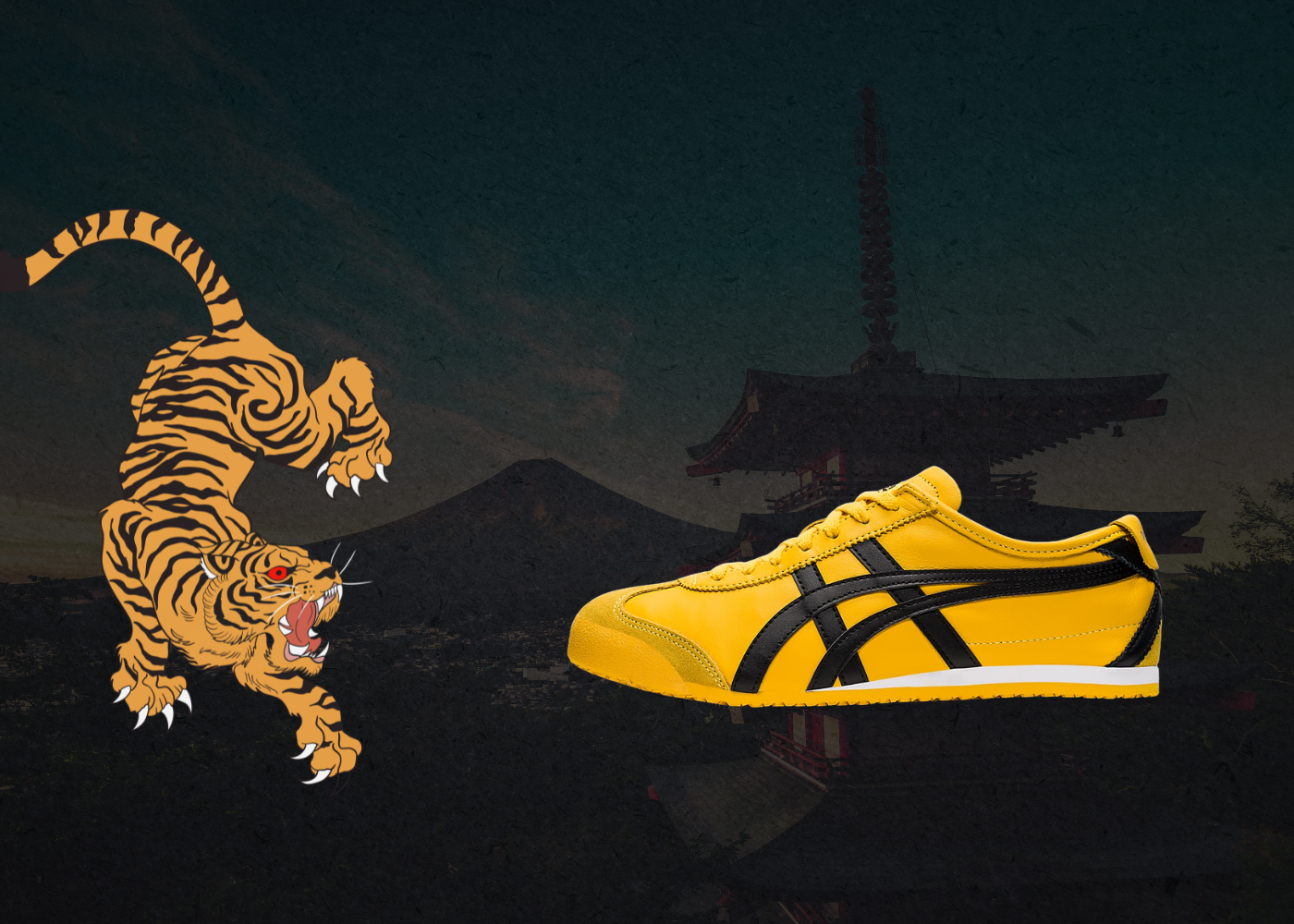
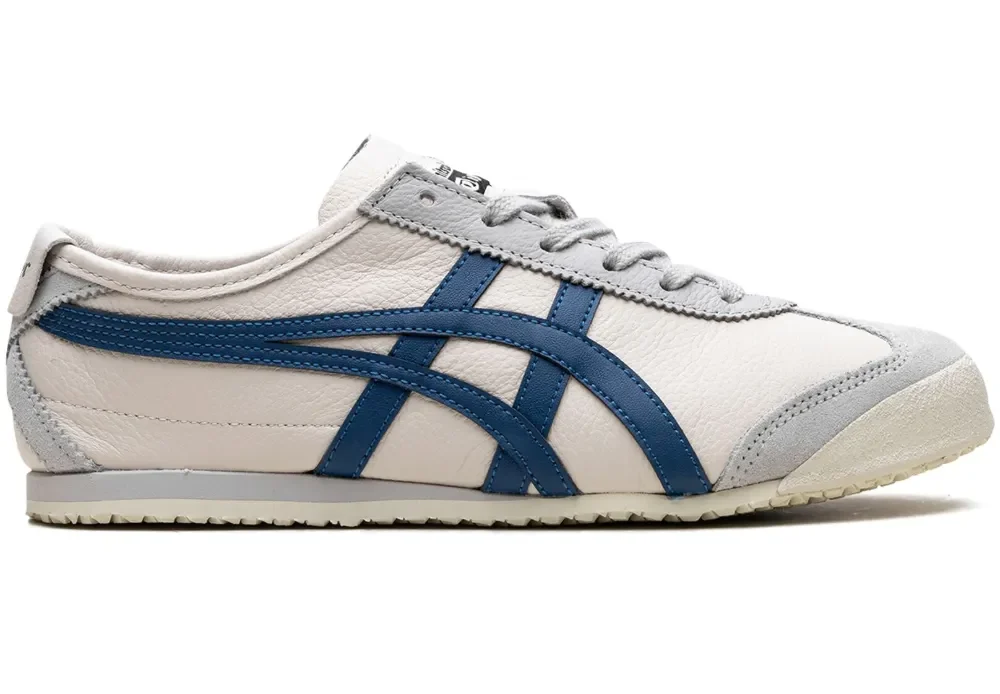
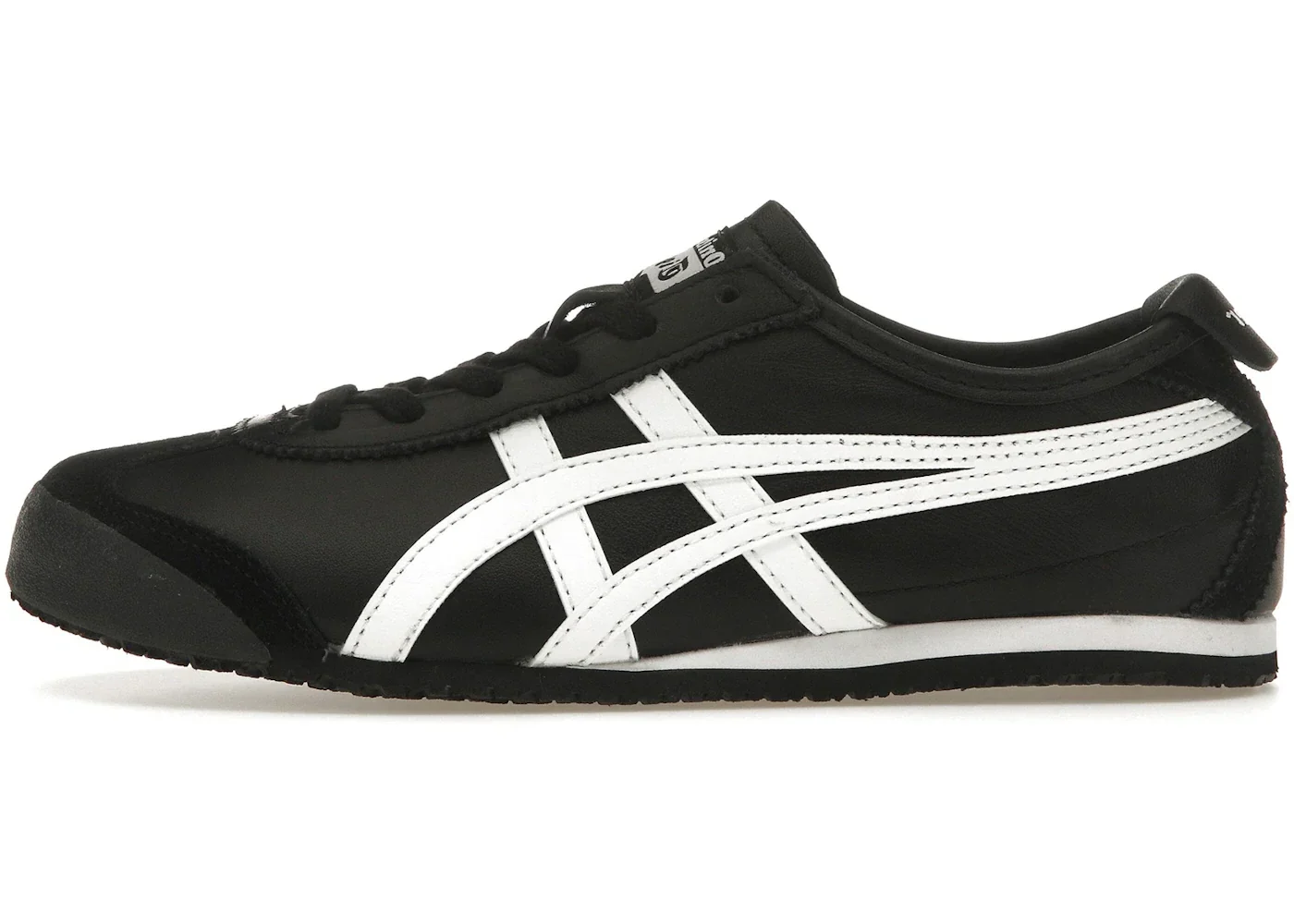
The Mexico 66 arrived as a training shoe for the Japanese team ahead of the 1968 Mexico City Olympics, and it introduced the crossed stripes that became the company’s signature. Those stripes later evolved into the ASICS logo.
The corporate history: Onitsuka merged with GTO and JELENK in 1977 to form ASICS, and the Onitsuka Tiger name went dormant. It was revived in 2002 as a deliberately fashion-facing heritage line — which is where the modern business begins.
The cultural moment came in 2003, when Uma Thurman wore a yellow-and-black Mexico 66 in Kill Bill. That pairing has never really stopped working.
If you want the same story told from a different country, our piece on the terrace shoe turned loafer covers how a sports silhouette gets laundered into a fashion object.
What Onitsuka Tiger Costs in India
Now the part that actually matters for readers here, and there is a genuinely useful surprise in it.
The Mexico 66 lists at around ₹7,999 on Ajio Luxe. US retail on the same shoe is roughly $90 — about ₹7,900 at current rates.
That is essentially price parity, which is close to unheard of for an imported sneaker in India.
Why it happens. Onitsuka Tiger runs official Indian distribution — its own India site, plus Ajio Luxe and Tata CLiQ Luxury — and mainline production sits in Indonesia rather than Japan. ASEAN trade arrangements mean the duty burden is nothing like the stack on European luxury footwear, which as we documented in the import duty breakdown runs to roughly 42%.
The practical conclusion: do not import these. This is one of the few genuinely global sneakers where the Indian price is already fair. A Tokyo store run, a US sale or a proxy service will not beat ₹7,999 once shipping lands — and after 1 November, the Japan route gets worse, not better.
Also worth noting: the Onitsuka Tiger Gymnarina at around ₹14,500 was our pick of the ballet-sneaker category, so the brand is doing interesting work here beyond the Mexico 66.
Prices verified in early September 2026 — check current listings, as Indian footwear pricing moves with sale cycles. For wider context on domestic price expectations, India’s biggest sneaker brand sells shoes for ₹683.
Made in Japan? Mostly Not
An honest note, since the entire appeal here is Japanese-ness.
Mainline Onitsuka Tiger — including the standard Mexico 66 — is manufactured largely in Indonesia and Vietnam. The shoe is Japanese by design, brand and heritage, not by assembly.
If you specifically want Japanese manufacture, that is the Nippon Made line: hand-finished models built in Japan, typically running $350 to $480 against the mainline’s $90 to $150. Different product, different price, genuinely different construction.
Neither is dishonest. But “Japanese sneakers” is doing a lot of work in most coverage of this brand, and it is worth knowing exactly which part is Japanese.
Which Onitsuka Tiger Model to Buy
Mexico 66 — the one you actually want. Slim, low, leather, crossed stripes, and the shoe carrying the whole brand. Around ₹7,999 in India. Runs narrow and slightly long; try before buying, or size down half if you know you have a slim foot.
Mexico 66 Slip-On — same upper, laceless. Easier to wear, less structured.
Serrano — thinner, more nylon-and-suede, closer to a 1970s running shoe. Cheaper and less recognisable, which some people will consider a feature.
Gymnarina — the ballet-sneaker interpretation, around ₹14,500, and the best-value pair in that whole category.
Nippon Made Mexico 66 Deluxe — for the enthusiast. Japanese production, premium leather, roughly four times the price.
On care: mainline Mexico 66 uppers are smooth leather, which is more monsoon-tolerant than mesh or suede but still stains. Our sneaker care archive has the method.
The Verdict
The easy version of this story is that a weak yen and a Kill Bill sneaker created a tourist boom. That version is real, it is mostly over, and it was never the important part.
The important part is that Onitsuka Tiger has found the highest-margin position in footwear — selling a finished sixty-year-old design with no athlete to pay, no foam to invent and no product cycle to fund — and that its fastest growth is now coming from Europe, where none of the tourist mechanics apply.
Asics clearly sees it. You do not build a separate global headquarters, hand it 190 stores and 2,800 people, and give it its own chief executive for a business you think peaked with the exchange rate.
For anyone reading this in India, the practical answer is unusually simple. The Mexico 66 costs about ₹7,999 here, which is roughly what it costs in America. Buy it locally, buy it now if you want it, and ignore every post telling you a Tokyo store run is the smart move.
That window is closing on 1 November. It was never especially wide.
Key Takeaways
- Onitsuka Tiger sales rose 43% to ¥136.5 billion (about US$851 million) in FY2025, at a category margin near 38% — the highest of Asics’ five categories.
- Q1 2026 sales rose 33.8% to ¥37.8 billion, with the margin reaching 39.6%.
- The margin comes from having no signature athletes, no cushioning R&D and no design cycle to fund.
- In the most recent period, sales grew 35.9% while Japan’s tourist count fell 2%, and Europe grew 66.5% — the Tokyo queue is marketing, not the business.
- Japan replaces its at-the-register tourist tax exemption with an airport refund system on 1 November 2026, adding friction to counter purchases.
- Asics moves the brand into OT Group Corporation on 1 January 2027, with ~190 stores, ~2,800 staff and distribution across ~160 countries.
- The Mexico 66 costs around ₹7,999 in India, roughly at parity with US retail — importing makes no financial sense.
- Mainline production is in Indonesia and Vietnam; only the Nippon Made line is made in Japan.