

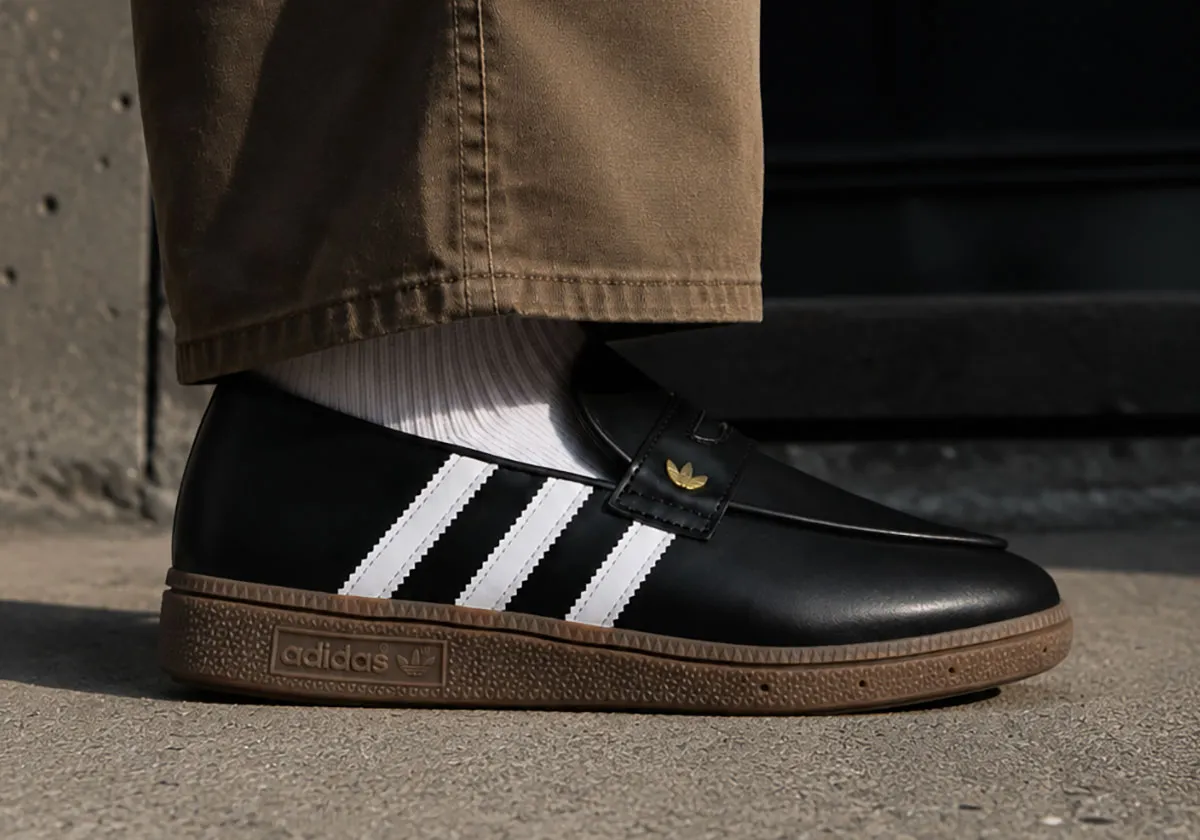
That detail comes from Ivy League campuses in the mid-twentieth century, where students slid a penny into the saddle of their Norwegian-derived loafers as a personal flourish. It is one of the most middle-class signifiers in all of footwear.
It is now sitting on top of a shoe whose cultural weight comes almost entirely from British football terraces in the 1980s.
That collision is either the smartest thing adidas has done this year or a small act of vandalism, depending on how much the original meant to you.
Probably both.
What the Handball Spezial Loafer Actually Is
Strip the discourse away and the construction is simple.
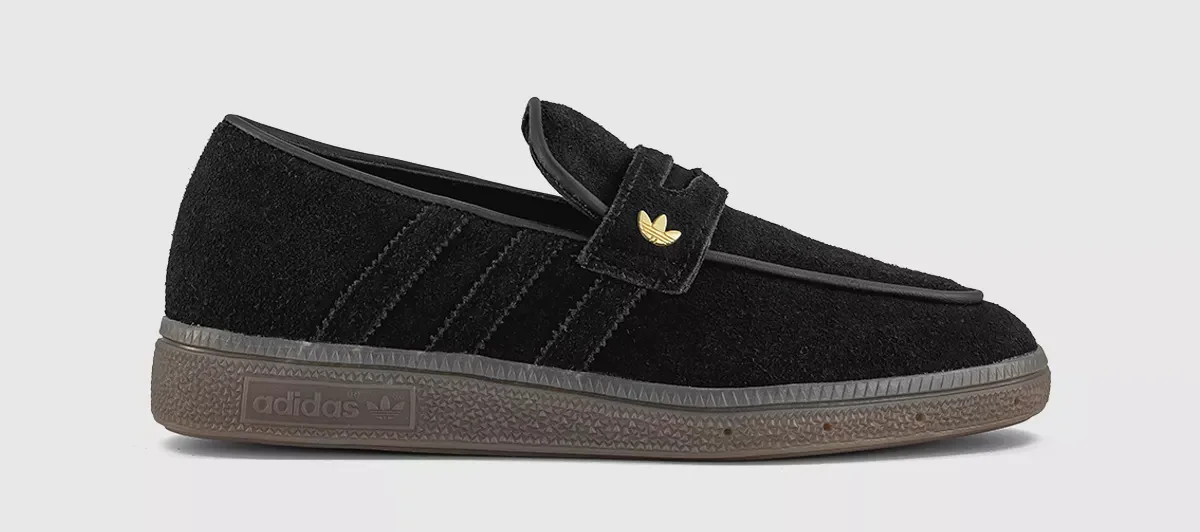
adidas has taken a penny loafer upper — moccasin-style, laceless, with a saddle strap across the vamp — and mounted it on the Handball Spezial’s flat gum cupsole.
| Element | Detail |
|---|---|
| Upper | Suede, moccasin construction, no laces |
| Strap | Penny-loafer saddle across the vamp, coin slot |
| Branding | Serrated Three Stripes in tonal leather; Trefoil on tongue or strap |
| Lining | Leather and felt |
| Footbed | Cushioned textile |
| Sole | Spezial three-zone gum cupsole |
| Sizing | Unisex, generally true to size |
The Three Stripes are rendered in matching leather rather than contrast, which keeps the whole thing quiet. On several colourways they are barely legible from a distance — deliberate, and the main reason the shoe reads as a loafer first and a sneaker second.
K&B Take: The restraint is the achievement here. It would have been very easy to make a loud shoe. adidas made a shoe you could wear to a meeting where nobody comments on it.
Wait — Is This Even a Spezial?
Worth being honest about this, because the marketing will not be.
Sneakerjagers made the observation cleanly when the first images landed: the upper bears very little resemblance to the original Handball Spezial. The rubber cupsole is essentially the only element carried over intact.
No lace panel. No lace eyelets. No padded collar of the original height. No contrast Three Stripes running the flank in that unmistakable Spezial proportion.
What you have is a penny loafer wearing a Spezial’s shoes.
That is not automatically a criticism — plenty of great footwear is built on borrowed soles. But if you are buying this expecting it to feel like your Spezials, adjust. It will feel like a loafer. That is the entire point of it.
Why the Spezial and Not the Samba
adidas had options here. It chose well.
The Samba is too famous. It has spent three years as the default sneaker of every city on earth, and putting a penny strap on it would have read as a cash-in on a silhouette already at saturation.
The Spezial has always been the connoisseur’s pick of the terrace trio — Samba, Gazelle, Spezial. Suede where the Samba is leather. Slightly less recognised, slightly more particular. It carries the same lineage without the same exhaustion.
There is also a material argument. The Spezial has always been a full-suede shoe, and suede is what a loafer wants. Converting the Samba would have meant either abandoning its leather identity or building a leather loafer that looked like a dress shoe pretending to be a sneaker, rather than the reverse.
The Terrace History That Gives This Weight
The Handball Spezial arrived in 1979 as a genuine indoor sports shoe — full suede upper for mobility, reinforced heel cap, and a grippy sole designed for pivoting on a wooden court.
It did what a lot of adidas indoor models did in that era, which is escape the sport almost immediately.
Through the 1980s it became a fixture of British football casual culture, worn on terraces up and down the country, frequently chosen in colourways matching a supporter’s club. That is a specific kind of cultural ownership. It was not a shoe you wore to look smart. It was a shoe that signalled you knew things.
Its second life arrived in the 2020s, pulled along in the slipstream of the Samba and Gazelle revival and amplified considerably by TikTok. Colourways like Earth Strata became genuine street-style staples.
So the arc runs: sports equipment, then subcultural badge, then mainstream fashion object, and now — with a coin slot across the vamp — an office shoe.
That final step is the interesting one. A shoe built to signal you were not dressed for the office is now being sold as a shoe for the office. Whether that is evolution or laundering depends entirely on whether you were there for the second step.
We have watched a similar arc play out from a different angle with the low-profile ballet sneaker, where a sports silhouette gets softened until it can pass in rooms sneakers were never allowed into.
Where It Sits in the Sneaker-Loafer Wave
adidas is not early here. It is arguably last.
New Balance opened this category with the 1906L, a loafer conversion of the 1906R, and the rest of the industry followed quickly. Hoka produced the Speed Loafer. Converse and Nike have both fielded versions. For roughly a year, sneaker-loafers have been one of the most consistently productive ideas in footwear.
adidas has been busy in adjacent territory — the Samba Jane took the balletcore route, and a run of bowling-inspired reworks covered another flank — but a true loafer conversion was the obvious gap in its lineup.
Arriving late has an upside. The category’s early experiments looked awkward: running silhouettes with high stacks and technical uppers do not naturally become dress shoes, and several attempts read as costume. A flat terrace shoe with a gum cupsole is a far more natural base for a loafer, because it was already close to the ground and already made of suede.
This is the one that should have existed first.
Price and Colourways
Here the reporting gets messy, and we would rather flag that than pretend.
Coverage at launch quoted €120 in Europe, roughly $141. Highsnobiety listed a pair at $110 on adidas’ own site around the same time. More recent US coverage of the black-and-white release puts it at $130 in women’s sizing.
The likeliest explanation is that pricing varies by region, colourway and material — the leopard and premium suede versions will not sit at the same number as a plain black. Check the specific pair rather than trusting any single figure, including ours.
Colourways released or announced so far include:
- Black Gum
- Aurora Cocoa / Aurora Coffee
- Magic Beige
- Cream / off-white
- Maroon Gum
- Leopard
- Black and white
The leopard is the one generating noise. The brown suede is the one that will still look correct in three years.
Reporting on the black-and-white release noted several sizes selling out quickly, so this is not a shoe to think about for a fortnight.
Comfort, Fit and the Honest Caveat
The Spezial sole is flat. Deliberately so — it was designed for court feel, not cushioning.
adidas has added a cushioned textile footbed and a felt-and-leather lining that moulds with wear, which helps. But nobody should buy this expecting running-shoe softness underfoot. The honest comparison is a comfortable loafer, not a comfortable sneaker.
For fit, the Handball Spezial generally runs true to size, and the loafer is reported to follow suit. Loafers are less forgiving than laced shoes, though — there is no lacing to compensate for a narrow or wide foot, so if you are between sizes, try before committing.
Suede without laces also means the shoe relies on the throat and strap to hold your foot. Expect some heel movement in the first few wears while the lining beds in.
Who Should Buy It
Buy if you:
- want one shoe that survives an office, a dinner and a walk home
- already own Spezials or Sambas and want the smart version
- prefer suede to leather
- are tired of loafers that look like you borrowed them from a solicitor
- want in on the sneaker-loafer category with something that actually suits the format
Skip if you:
- need real cushioning for long days on your feet
- live somewhere wet — see the India section below
- wanted a Spezial and will be annoyed that this is not really one
- already own the New Balance 1906L and are not collecting the category
Buying It in India
Where to look. VegNonVeg, Superkicks and Mainstreet Marketplace are the reliable domestic routes for adidas Originals releases, alongside adidas’ own India site and stores. Availability of specific colourways is the usual problem — international drops reach India inconsistently and often late.
Price band. Expect the loafer to land somewhere in the ₹11,000–16,000 range domestically once it arrives, based on where comparable adidas Originals suede models sit. Treat that as a ballpark, not a quote. Sneaker pricing here moves with duties, exchange rates and sale cycles.
If you import. Duties on footwear entering India are substantial, and as we documented in the Hermès sneaker guide, the stack on luxury footwear runs to roughly 42% before a reseller takes anything. A grey-market pair can easily cost more than double what it does abroad.
Counterfeit warning. The Spezial family is heavily faked in the domestic grey market, and a loafer conversion is easier to approximate than a laced shoe — there are fewer details to get wrong. Check the sole’s three-zone geometry, the serration on the Three Stripes and the quality of the suede nap. Buy from authorised stockists.
The monsoon problem, which is real. This is a suede shoe with no laces and a felt-lined interior. It is close to the worst possible construction for an Indian wet season. Suede water-stains, felt holds damp, and a laceless shoe cannot be loosened to dry properly. If you buy this, buy it as a dry-season shoe, protect it before first wear, and read our sneaker care archive before you find out the hard way.
For the wider domestic context on what Indians actually pay for footwear, our report on why India’s biggest sneaker brand sells shoes for ₹683 is a useful reality check.
The Verdict
The adidas Handball Spezial Loafer is a genuinely well-judged shoe. Restrained branding, the right base silhouette, and a material choice that suits the format better than anything else in the sneaker-loafer category so far. Arriving late, adidas has produced the version that makes the most sense.
It is also barely a Handball Spezial, and worth being clear-eyed about that. This is a penny loafer that borrowed a famous sole and a famous name.
Whether that bothers you is a question about what the shoe meant to you before. If the Spezial was simply a nice suede sneaker you saw on TikTok, this is a clever extension of something you already like. If it was a terrace shoe — a thing that meant something specific, in specific towns, to specific people — then watching it acquire a coin slot for Ivy League pennies is a slightly strange experience.
Neither reading is wrong. Shoes outlive the people who gave them meaning, and they always have.
Buy the brown suede. Keep it out of the rain.
Key Takeaways
- The adidas Handball Spezial Loafer places a penny-loafer suede upper on the Spezial’s flat three-zone gum cupsole.
- Only the sole meaningfully carries over from the original — the upper is a loafer, not a Spezial.
- The Handball Spezial launched in 1979 as an indoor handball shoe and became a British football terrace staple through the 1980s.
- adidas is late to the sneaker-loafer category, which New Balance opened with the 1906L, but the flat suede base suits the format better than a technical runner does.
- Reported pricing spans roughly €120 in Europe and $110–$130 in the US, varying by colourway and market.
- The sole is flat and low-cushion by design; expect loafer comfort, not sneaker comfort.
- In India, expect roughly ₹11,000–16,000, verify before buying, and treat it strictly as a dry-season shoe.