


Let’s be honest about what a nursing shift actually is. It’s several miles of walking. Hours of standing on floors with roughly the give of a car park. Sudden sprints to a room. The occasional mystery spill you’d genuinely rather not identify. And all of it, back to back, for twelve hours — before you clock in and do the whole thing again tomorrow.
Your feet, frankly, deserve hazard pay.
The wrong shoes turn all that into aching arches, screaming knees, a furious lower back, and that special end-of-shift shuffle to the car where you look like you’re auditioning for a zombie film. The right shoes? They quietly vanish, hold you up, wipe clean, and let you focus on the actual job instead of your throbbing heels.
So here’s our field guide to the best sneakers for nurses — what to look for, the pairs genuinely worth your money, and how to make them last. (Bonus: these are exactly the shoes worth pouncing on the moment they drop in price on Amazon.)
What to look for in a nurse-proof sneaker
Nursing is uniquely brutal on footwear, so a good pair has to tick more boxes than your average trainer. Here’s the checklist.
Cushioning, and plenty of it. When you’re on hard floors all day, plush, high-stack cushioning is your suspension system. Shoes with generous foam and a rocker-style sole (Hoka’s entire personality) roll you smoothly through each step and take a serious load off your legs.
Real arch support. Your arches are pulling twelve-hour overtime, and the flimsy cardboard insert most “comfort” shoes ship with simply won’t cut it. Proper structured support is what keeps the dreaded plantar fasciitis at bay.
Slip resistance. Hospital floors plus spills is a recipe for a very bad day. Look for outsoles built to grip wet surfaces — ideally tested to a slip-resistance standard like ASTM F2913. Your tailbone will send flowers.
Easy to clean. You will get things on these shoes. Wipeable, water- or fluid-resistant uppers — coated mesh, leather, or purpose-built healthcare materials — mean a quick sponge-down instead of a biohazard situation.
Breathability. Twelve hours is a long time to marinate. A breathable mesh upper keeps your feet cooler, drier, and far less prone to blisters.
Easy on and off. Underrated, this one: hands-free “slip-in” designs mean you never have to touch your grubby work shoes to put them on. A genuine, daily quality-of-life upgrade.
And the right fit for your feet. Feet swell over a long shift, so wide-toe-box options matter, and many of these shoes run a touch big. More on sizing shortly.
Do you actually need “nursing” shoes?
Here’s a myth worth busting: you don’t need a shoe with “nursing” stamped on the box to survive a shift.
In fact, most podiatrists and nurses will happily tell you a quality running or walking shoe is often the smarter buy. They’re engineered for precisely what your feet endure all day — sustained impact, serious cushioning, and real arch support — usually with more advanced foam and better durability than a generic “nursing-specific” sneaker. It’s no coincidence that half the pairs nurses swear by (Hoka, Brooks, ASICS, New Balance) started life as running shoes.
That said, the healthcare-first brands do add genuinely useful touches — certified slip resistance, fluid-proof uppers, hands-free entry — that a standard running shoe might skip. So the honest answer is this: a great running or walking shoe will serve most nurses brilliantly, and a purpose-built healthcare shoe earns its keep if slip resistance and easy cleaning are non-negotiable on your ward.
The best sneakers for nurses, by need
Every nurse — and every foot — is different, so here are the standouts sorted by what you need most. (All of these go on sale regularly, so always grab them when the price dips.)
Best plush, all-day cushion: the Hoka Bondi. The reigning champion of nurse footwear, and for good reason — pillow-soft max cushioning and a rocker sole that makes twelve hours on concrete feel almost humane. If you want maximum comfort and couldn’t care less about a chunky look, start right here.
Best all-rounder: the Brooks Ghost (and the taller-stacked Ghost Max). Balanced, neutral cushioning without the bulk, endlessly reliable, and beloved by thousands upon thousands of nurses. The safe, do-everything pick that’s genuinely hard to get wrong.
Best leg-saver: the New Balance Fresh Foam X More. An almost absurdly tall stack height sitting on a wide, stable base makes this one of the softest, most fatigue-fighting shoes going. When your legs are already dead by lunch, consider this the reset button.
Best for flat feet or overpronation: the Brooks Adrenaline GTS. If your feet roll inward, you want stability, and the Adrenaline is a bona fide classic — guided support that quietly keeps everything aligned. The Saucony Guide and New Balance 860 are excellent alternatives in the same lane.
Best breathable do-it-all: the ASICS Gel-Nimbus. Lightweight, seriously cushioned, and airy thanks to a breathable mesh upper — and versatile enough to moonlight as your gym or running shoe on your days off.
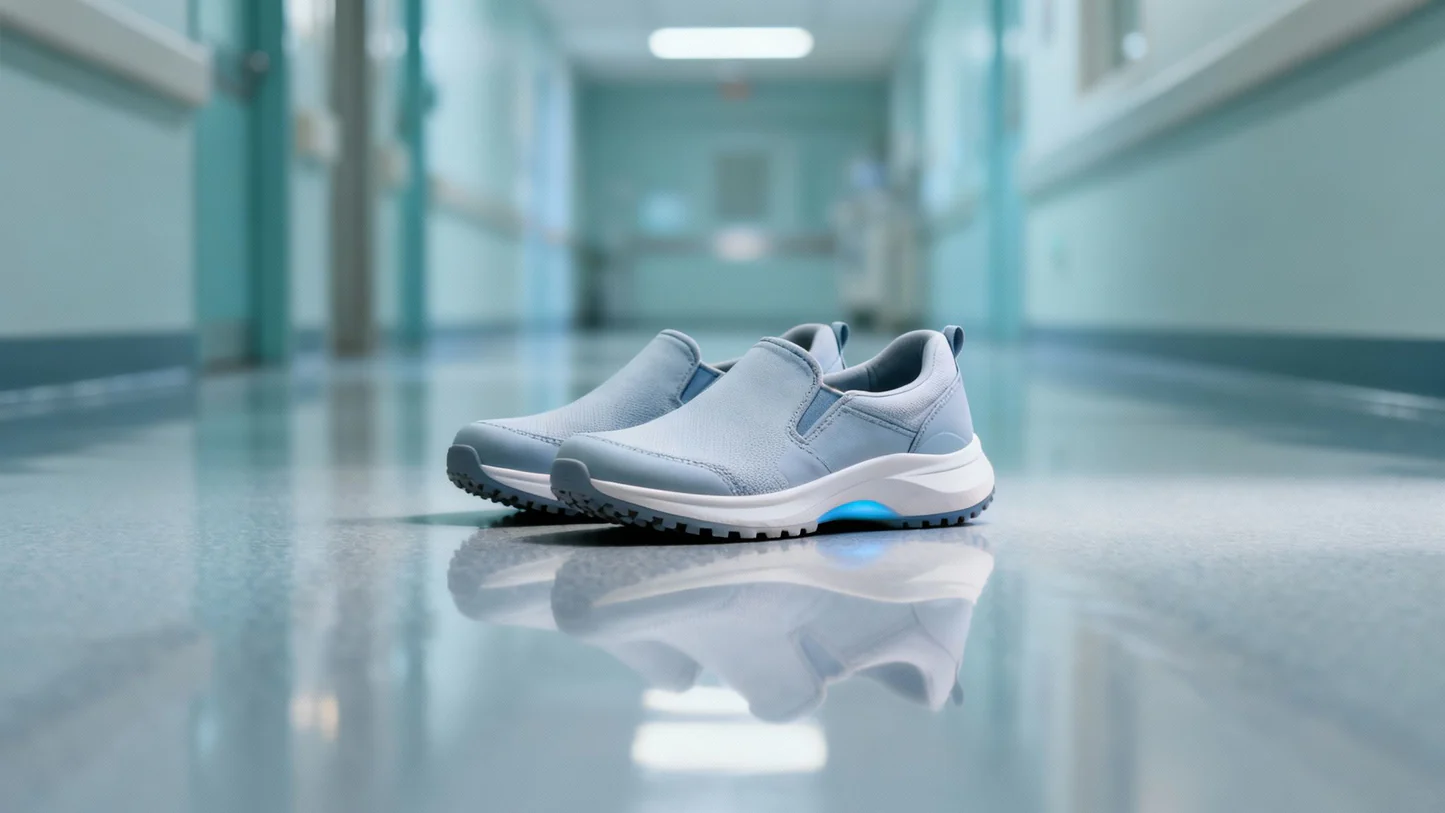
Best slip-on (and best value): the Skechers Slip-ins. Hands-free, memory-foam-comfortable straight out of the box, easy on the wallet, and wildly popular with healthcare workers who are done with laces forever.
Best built-for-healthcare: Clove. A brand designed from scratch for exactly this job — slip- and fluid-resistant, easy to wipe down, often antimicrobial-treated, and hands-free, developed with input from actual healthcare pros. If you want a shoe that speaks fluent hospital, this is the one.
Sneakers vs clogs vs Crocs vs slip-ins
Ah yes, the great nursing-footwear holy war. Every break room has its rival factions. Here’s the quick, honest scorecard.
Athletic sneakers are the all-round winners for most people: the best cushioning, support, and impact protection money can buy, which is precisely what twelve hours demands. If you’re unsure where to start, this is the safe bet.
Clogs (hello, Dansko) are the old-school icons for good reason — supportive, durable, easy to slip on and wipe clean, and great for roles that involve more standing than sprinting. The trade-off is less springy cushioning than a modern max-stack sneaker.
Crocs (and the comfier LiteRide-style ones) are the budget-friendly, ultra-cleanable crowd favourite. Perfectly fine for shorter shifts and gloriously easy to hose off, but they generally surrender support and stability next to a proper sneaker — go in with your expectations set accordingly.
Slip-ins are less a category than a superpower. Any shoe you can shove your foot into without bending down — or touching it — is a small daily gift when you’re running on four hours of sleep. These days it’s often the deciding feature rather than a mere nice-to-have.
The verdict? For most nurses, a well-cushioned athletic sneaker (ideally a slip-in one) takes it. But if your feet genuinely love clogs, don’t let anyone in the break room talk you out of them.
Fit, sizing, and when to replace
A perfect shoe in the wrong size is just an expensive blister machine, so get this bit right.
Size for the end of your shift, not the start. Feet swell over twelve hours, so try shoes on in the evening or after being on your feet, and leave roughly a thumb’s width of room up front. Many of these heavily cushioned models also run slightly large, so don’t be surprised if you land half a size down from your usual. If you’ve got wider feet or deal with bunions, hunt down the wide and extra-wide options — most of these brands offer them.
One small extra that punches above its weight: your socks. A decent moisture-wicking pair cuts friction, fights blisters, and stops sweaty feet from turning your lovely new shoes into a swamp by hour eight. Cheap upgrade, big payoff.
Then, the part almost everyone ignores: these shoes have a shelf life. All that lovely foam slowly compresses and packs out, and once it does, the shoe quietly stops protecting your joints even if it still looks perfectly fine on the outside. Working three or four shifts a week, plan to replace your main pair roughly every four to six months. The genuine pro move is to rotate two pairs — it lets the foam bounce back between shifts and makes each pair last noticeably longer. Your feet get fresh cushioning; your wallet gets a well-earned break.
The bottom line, in 30 seconds
For the nurse reading this on a thirty-second break, here’s the entire thing distilled.
Prioritise serious cushioning and real arch support — your joints are the ones on the line.
Insist on slip resistance and a wipe-clean, breathable upper.
Slip-in, hands-free designs are worth it for the sheer convenience alone.
Match the shoe to your feet: stability for overpronators, plush neutral for everyone else.
Size for swollen, end-of-shift feet, and grab wide options if you need them.
Replace every four to six months, and rotate two pairs to stretch their life.
And if you just want a safe bet: a Hoka Bondi or a Brooks Ghost will keep almost any nurse standing. Keep an eye on Amazon, pounce the second they go on sale, and go easy on those feet — you’ve more than earned it.