

Here’s a fact that should bother anyone who cares about Indian footwear: Agra is one of the largest shoe-producing cities on earth, and for most of its modern history almost nothing leaving it has carried an Indian brand name.
The city’s factories have exported to Europe, the Gulf and Africa for decades. The craft is genuinely world-class. The labels stitched inside were almost always somebody else’s.
That’s changing, slowly, and not because of a policy or a campaign. It’s changing because a handful of manufacturers restructured to serve small orders instead of only large ones — and the moment 300 pairs became viable, a generation of Indian D2C founders could suddenly afford to exist.
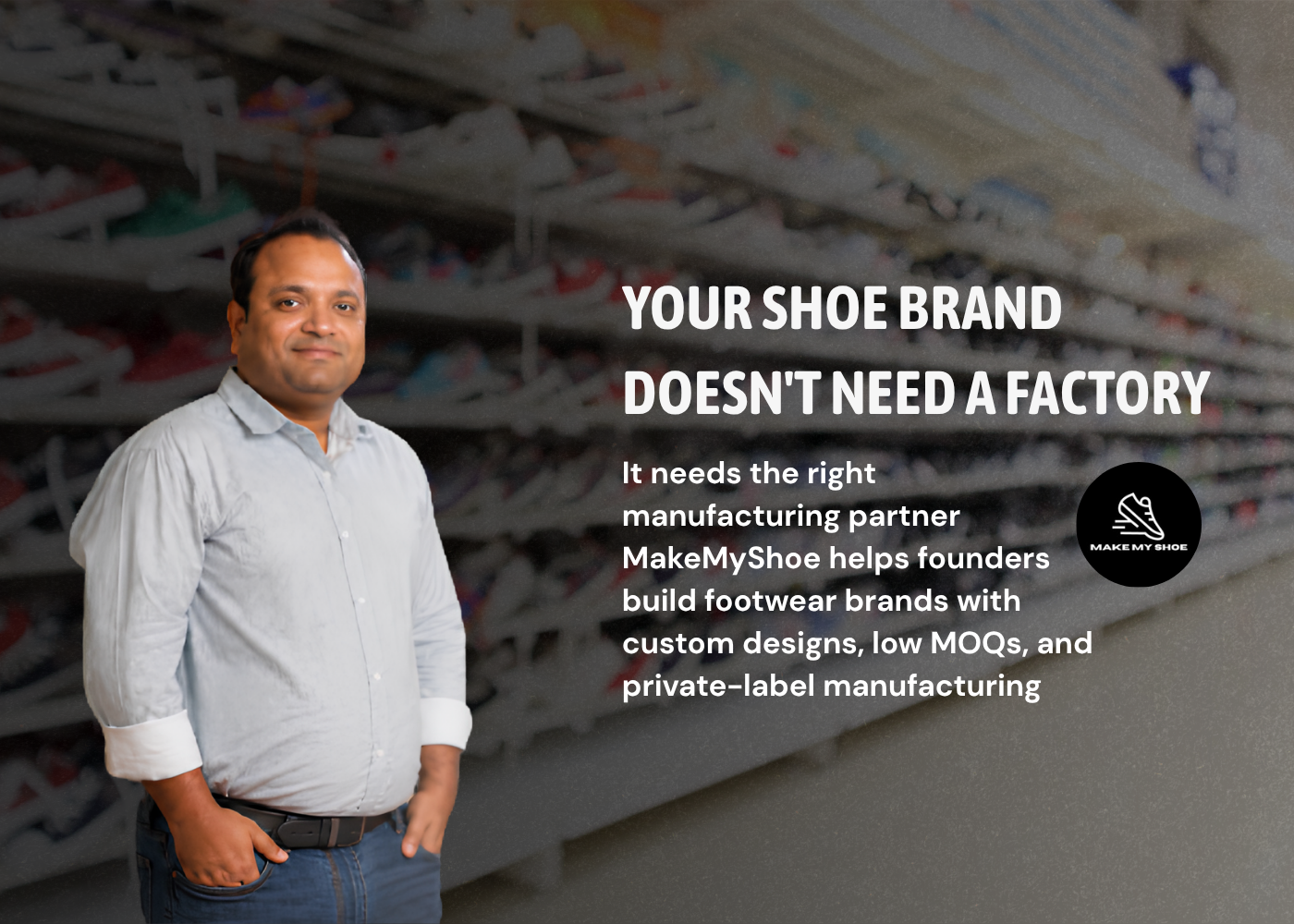
Make My Shoe is one of those manufacturers. Based in Agra, it works with startups, D2C labels and established sellers who want footwear produced under their own brand. We looked at how the operation works, what founders can realistically expect, and — just as usefully — what to ask before committing money.
Why Agra Matters
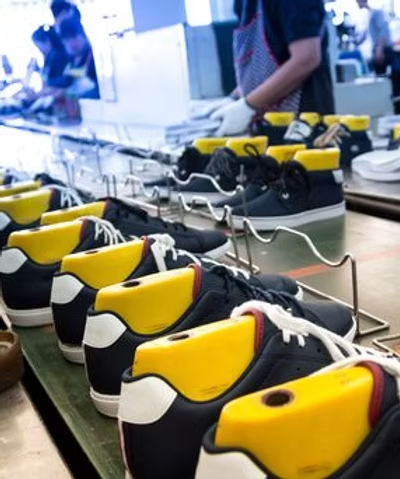
India’s footwear manufacturing is regional, and the regions specialise. Leather work concentrates in Agra and Kanpur. Sports footwear built around mesh and EVA clusters near Delhi NCR. Chennai handles significant export volume.
Agra’s advantage is depth of skill. Generations of pattern cutters, laster and finishers, plus a component supply chain that’s been feeding the industry for decades. When you commission a shoe there, you’re not paying someone to learn on your order.
The broader economics work in India’s favour too. Production costs run meaningfully below China’s for comparable quality, and — the part that actually matters for a small brand — minimum order quantities are far lower. Chinese factories typically want 1,000+ pairs. Indian units frequently work from a few hundred.
That single difference is what makes a first run possible for a founder with savings rather than funding.
What Make My Shoe Actually Does
Make My Shoe describes itself as a one-roof solution for custom bulk footwear — design through delivery, produced under the client’s brand.
In practice the offer breaks into four things:
Private label manufacturing. Shoes made under your name, to your specification. You own the brand; they handle production, quality control and logistics.
Design and development. For founders arriving with a sketch or just a concept rather than a technical pack, the company positions itself as guiding clients through design, development, branding and packaging — explicitly aimed at people without prior footwear experience.
Custom branding and packaging. Logo application, branded boxes, packaging built for retail rather than generic cartons. For a D2C brand, unboxing is product, and generic packaging undermines a good shoe.
Consultation. The company offers free initial consultation, which is worth using as a diagnostic — how a manufacturer handles a first conversation tells you a great deal about how they’ll handle a problem later.
The company states it has served over 150 clients and works with a team of more than 100 craftspeople. These are company-stated figures rather than independently audited numbers — treat them as indicative.
The Eight-Stage Process, Explained
Make My Shoe publishes its production sequence in full, which is more transparency than most manufacturers offer. It’s worth walking through, because understanding it is how you avoid being sold a shortcut.
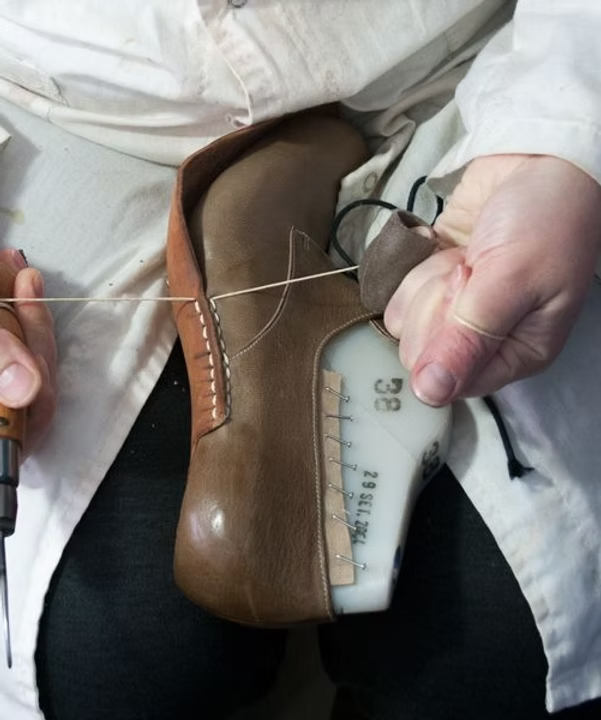
1. Concept development and design. Trend research, material and colour selection, and 2D/3D design work. This is where a vague idea becomes something a factory can quote against.
2. Material sourcing. Leather, mesh, synthetic and eco-friendly options for uppers; EVA, TPR, PU and rubber for soles, plus branding hardware. Founder note: sole choice drives both cost and character more than anything else you’ll pick.
3. Pattern making and cutting. Pattern development plus computerised cutting to reduce waste. Accuracy here determines whether the shoe fits — and material wastage is a real line item in your unit cost.
4. Prototype and sample development. Samples produced for approval, fit testing and adjustment before bulk. Do not skip this and do not rush it. More on why below.
5. Upper stitching. Reinforced stitching, logo and label integration. This is where the shoe starts looking like a product rather than components.
6. Sole attachment and lasting. The shoe takes its shape. Bonding or direct injection depending on construction.
7. Finishing and quality control. Defect inspection, cleaning, polishing and performance testing.
8. Packaging and delivery. Branded packaging, bulk fulfilment, domestic and global shipping.
The stage that decides whether your brand survives its first year is stage four. A sample you approved in a hurry becomes 300 pairs you can’t sell. Sample more than once. Wear the sample. Give it to someone with different feet and make them wear it too.
MOQs, Timelines and the Low-Minimum Question
This is the part founders care about most, so here it is plainly.
| Factor | What Make My Shoe States |
|---|---|
| MOQ | Varies by shoe type, design complexity and customisation; low MOQs supported for startups and emerging D2C brands |
| Production timeline | Typically 3–5 weeks depending on order size and customisation |
| Samples | Prototype samples provided before bulk production |
| Materials | Knit, mesh, synthetic leather, EVA soles, rubber soles, sustainable options |
| Product range | Sneakers, sports shoes, casual, running, lifestyle, custom designs |
Two honest observations.
First, the MOQ is not published as a fixed number — it’s quoted per project. That’s normal for custom manufacturing, since a simple canvas sneaker and a complex multi-panel leather shoe are entirely different production problems. But it does mean you cannot budget from the website. Get your minimum in writing, per style and per colourway, before you plan anything. Four colours at a 300-pair minimum is a 1,200-pair order, and that arithmetic has ended more first runs than bad design ever has.
Second, the 3–5 week production window is genuinely quick by industry standards — many first runs elsewhere take three to five months. Worth understanding why: that figure covers production, not the full development cycle. Design, material sourcing and multiple sampling rounds sit ahead of it. Plan your launch on the total timeline, not the production line.
What They Make
The catalogue spans men’s footwear, women’s footwear, leather footwear and orthopaedic shoes, with sneakers, sports shoes, running and lifestyle styles across the range.
Two things stand out for a sneaker audience.
Orthopaedic footwear is a serious category and an underserved one in India. It’s not glamorous, and it’s a genuinely good business for a founder willing to solve a real problem rather than chase a silhouette.
The sneaker capability is the interesting part. Knit, mesh and EVA construction is the modern sneaker vocabulary — it’s what most contemporary lifestyle footwear is actually built from. A domestic unit working comfortably in those materials is what makes an Indian sneaker label buildable without importing, and we’ve seen what that can produce with brands like Rare’Z and its OTIMO silhouette.
Who This Suits — and Who It Doesn’t
A Good Fit
- First-time founders without footwear experience. The design-and-development support is the actual value here, more than the manufacturing.
- D2C brands testing a category. Low minimums make a pilot run survivable.
- Sellers moving off generic stock. If you’re currently reselling unbranded inventory, private label is the obvious next step.
- Corporate, institutional and uniform buyers. Branded footwear for schools, teams or staff is a steady, unglamorous, profitable use case.
A Poor Fit
- Anyone wanting a fully bespoke sole mould on run one. Custom tooling amortised across a few hundred pairs is punishing. Use an existing sole until you have volume.
- Founders with no route to market. The manufacturing is the solvable half. Selling 300 pairs is the hard half, and no factory helps with it.
- Buyers wanting a single pair. This is bulk manufacturing. For one custom pair, you want a bespoke workshop, not a production line.
- Anyone who won’t sample properly. If your timeline can’t absorb two or three sampling rounds, your timeline is wrong.
What to Ask Before You Sign Anything
This applies to Make My Shoe and to every other manufacturer you speak to. Print it.
- “What’s the MOQ for this exact style, per colourway?” Get it in writing. Verbal flexibility evaporates at invoice time.
- “What’s the all-in per-pair cost including packaging, labels and QC rejects?” The quoted production figure is never the landed figure. Budget 20–30% above it.
- “Can I see the sample before bulk, and can I order a second revision?” Yes to both, or walk.
- “Which sole is this, and is it stock or custom tooling?” This one question explains most of your unit cost.
- “What happens to units that fail QC?” A real quality process has an answer ready.
- “Can I speak to a brand you’ve produced for?” Any manufacturer with a genuine track record can arrange it.
- “Do you hold BIS certification for this product category?” See below. This is the one that matters most.
None of these are hostile questions. A good manufacturer answers them without hesitation because they’ve been asked before. The reaction tells you more than a factory tour will.
The Compliance Detail Every Founder Misses
If you take one thing from this piece, take this.
Footwear sold in India falls under Quality Control Orders requiring BIS certification and the ISI mark across a broad range of categories. Most new founders assume this is something their brand applies for.
It isn’t.
BIS certification is granted to the manufacturing facility where final manufacturing takes place — not to the brand that designs or launches the product. It’s also site-specific: a manufacturer running multiple units needs a separate licence for each one.
What that means practically:
- Your manufacturer must already hold BIS certification for your product category. You don’t apply; they must have it.
- A licence for one footwear category doesn’t cover another. Ask for the licence number and the specific IS standard.
- Non-compliance has teeth. Products can be blocked, delisted from marketplaces, and manufacturers face legal penalties.
- Goods made purely for export sit outside these orders. Selling domestically? They apply.
Ask for the licence before you pay a deposit. Not after the samples. Not after the deposit. Before.
Regulations here have been amended and extended repeatedly. Verify current QCO scope with BIS or a compliance consultant before committing capital.
The Editorial Take
The interesting thing about manufacturers like Make My Shoe isn’t the factory. Agra has had excellent factories for a hundred years.
It’s the restructuring around small orders. For most of Indian footwear’s modern history, the economics only worked at export scale — which meant the only people who could commission shoes here were foreign buyers placing five-figure orders. Domestic founders were locked out of their own country’s manufacturing base.
Lowering the minimum changes who gets to have a brand. That’s not a marketing story; it’s an access story, and it’s the reason the next decade of Indian sneaker labels will look different from the last one.
It doesn’t make launching a footwear brand easy. You still need a product worth buying, a route to market, and enough capital to absorb a run that doesn’t sell. The factory solves the manufacturing problem and hands you all the others.
But the manufacturing problem used to be unsolvable for anyone without serious money behind them. Now it isn’t. That’s the shift worth paying attention to.
Make My Shoe: Agra, Uttar Pradesh · makemyshoe.co.in · connect@makemyshoe.co.in
Key Takeaways
- Make My Shoe is an Agra-based private label footwear manufacturer serving startups, D2C brands and sellers who want production under their own name.
- Production runs roughly 3–5 weeks, though that covers manufacturing only — design, sourcing and sampling sit ahead of it.
- MOQ is quoted per project, not published. Get it in writing per style and per colourway; multiple colours multiply your minimum.
- The eight-stage process is published in full, from concept through packaging — unusual transparency worth using as a checklist.
- Sampling is the stage that decides everything. Approve a sample in a hurry and you own 300 pairs you can’t sell.
- BIS certification belongs to the factory, not your brand. Ask for the licence number and IS standard before paying a deposit.
- The real story is access. Lower minimums mean Indian founders can finally commission from India’s own manufacturing base.
- Manufacturing is the solvable half. Selling the inventory is the half nobody will help you with.
Make My Shoe sits at a genuinely interesting point in Indian footwear — a city with a century of craft behind it, restructured to serve founders who couldn’t previously afford to place an order in their own country.
Whether it’s the right manufacturer for you depends on questions only you can ask: your MOQ, your sole, your all-in cost, their certification. Ask them properly and the answers will be clear either way.
What’s no longer in question is whether the option exists. For most of the last hundred years, the shoes leaving Agra carried someone else’s name. That’s a strange thing for a country with this much manufacturing skill, and it’s finally starting to look like a historical accident rather than a permanent arrangement.