


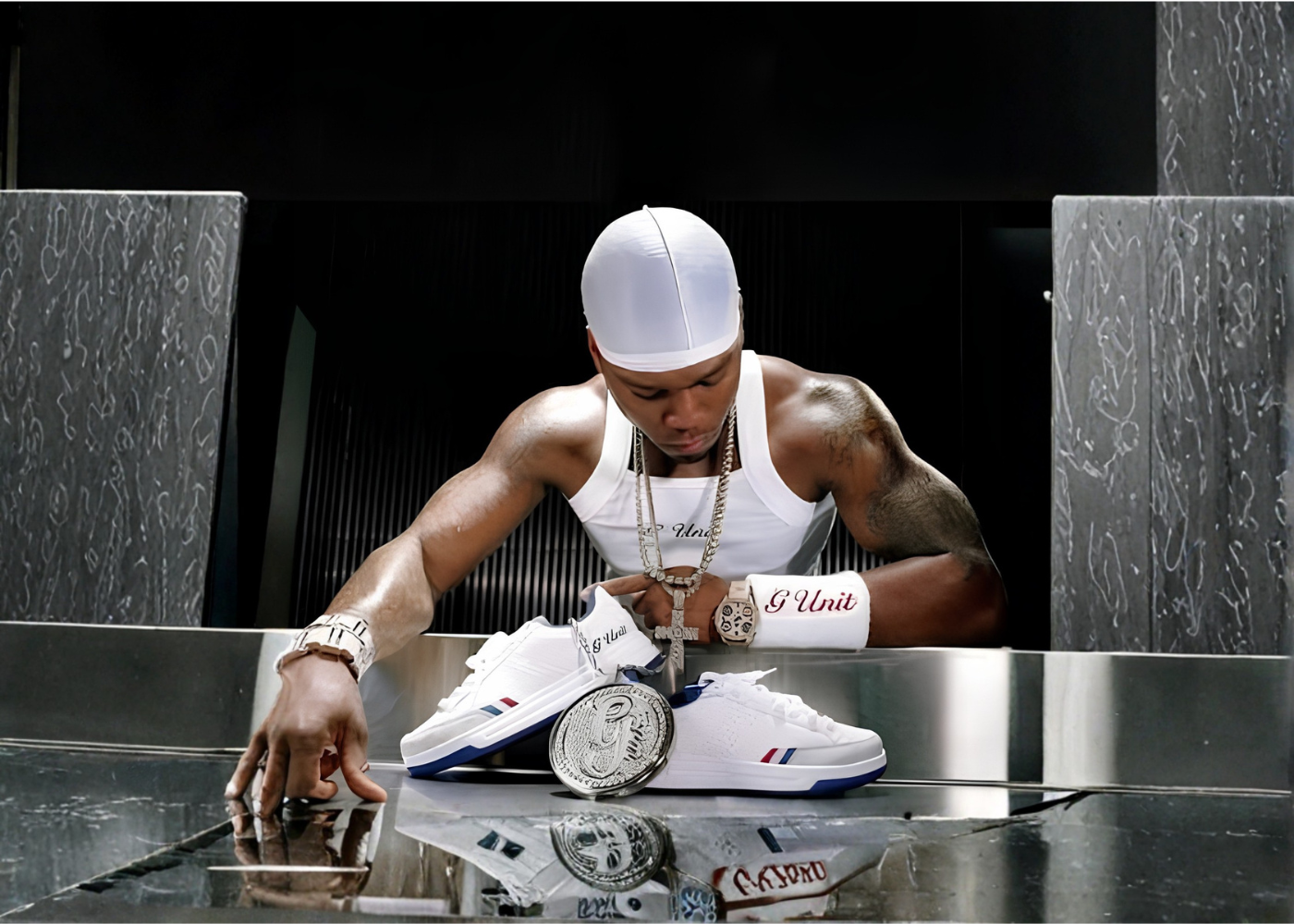
Search interest in g unit sneakers spiked more than 450% in a single day this week, and for once the internet is reacting to something real. After a leak, a denial-shaped shrug from 50 Cent, and three months of speculation, official images of the Reebok G-Unit G6 retro landed — and the shoe is arriving on August 20, 2026 at $130, in the exact white-and-royal colorway that made it a fixture in 2003.
No reworked midsole. No “reimagined” proportions. No collab tax. Reebok looked at a sneaker that sold in the millions two decades ago and decided the correct move was to make it again.
That restraint is the whole story here. Retro programmes usually get sanded down — softened toe boxes, updated foams, a tonal colorway to test the water. The G6 got none of that treatment, and the shoe is better for it.
The G Unit Sneakers Release: Everything Confirmed
Here is the short version, before the culture lesson.
| Detail | Confirmed Information |
|---|---|
| Model | Reebok G-Unit G6 |
| Colorway | White / Royal — the original 2003 palette |
| Style Code | 100289469 |
| Release Date | August 20, 2026 |
| Retail Price | $130 USD |
| Sizing | Men’s sizing at launch |
| Confirmed Stockists | Reebok, JD Sports, select retailers online and in-store |
| India Release | Not announced as of publication |
| Additional Colorways | Not announced |
Two caveats worth flagging. First, JD Sports currently carries the August 20 listing, but an earlier launch or a New York activation remains possible — Reebok has a history of celebrating anniversary moments with city-specific events, and the G6 is a New York shoe in every sense.
Second, nothing has been said about a wider colorway rollout. The G6 ran through dozens of variants in its original life — team colorways, camo, blacked-out pairs, kids’ sizing. Whether 2026 gets more than one is entirely dependent on how August 20 performs.
Why G Unit Sneakers Are Trending Right Now
The spike has a clear cause and a longer fuse.
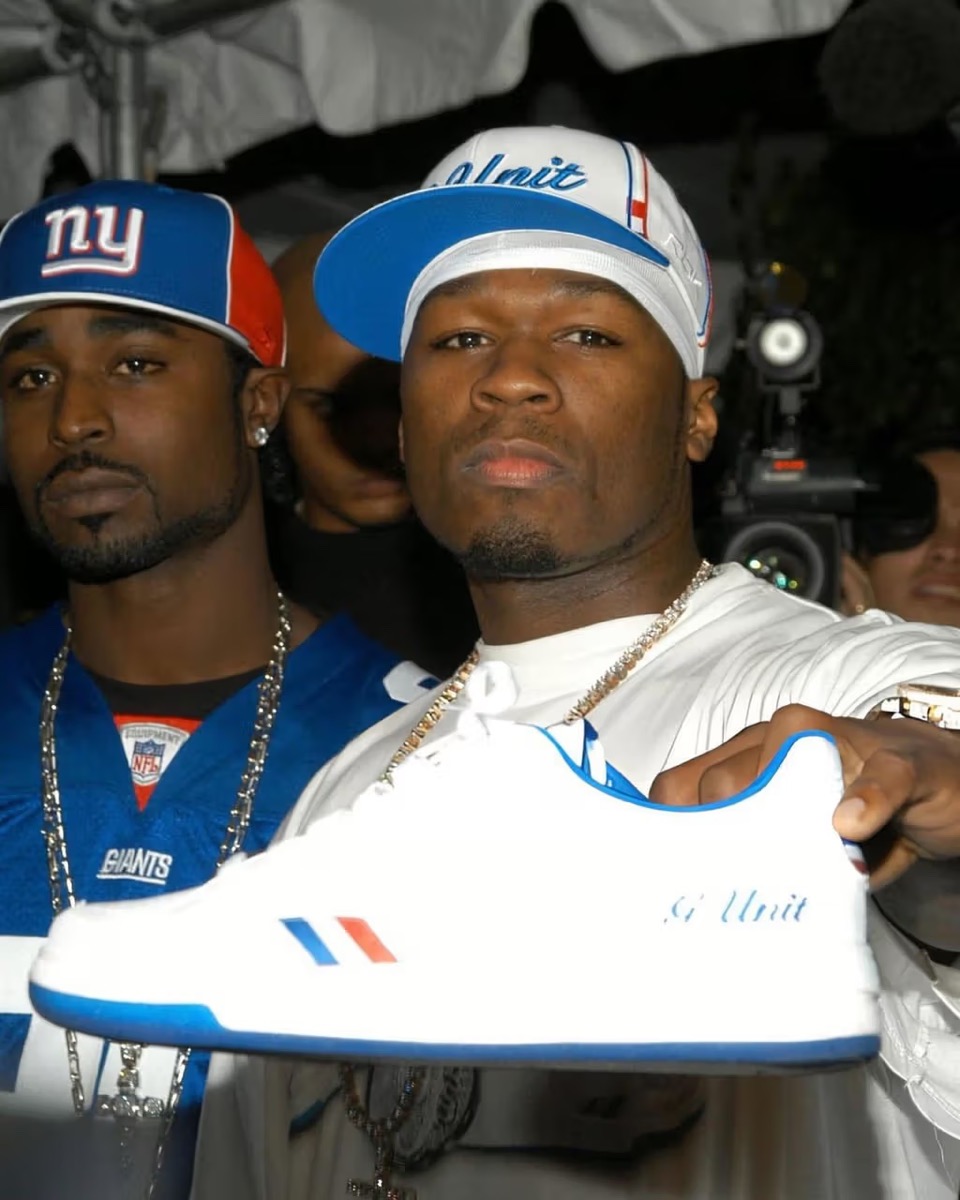
The immediate trigger: official product images surfaced this week, converting a rumour into a dated, priced, photographed release. Search behaviour follows imagery. People will speculate about a shoe for months and only start typing when they can see it.
The longer fuse started in May 2026, when Tony Yayo — appearing alongside Uncle Murda on their podcast The Real Report — casually confirmed the reunion before Reebok had said anything publicly. His delivery was about as ceremonial as a text message: the G-Unit sneakers are coming back, shout-out to Reebok. 50 Cent’s reported response to being scooped by his own artist was, roughly, that telling Yayo anything is a mistake.
That leak did something a press release couldn’t. It made the return feel like gossip rather than marketing, and gossip travels further.
Underneath both moments sits the structural reason: Y2K nostalgia has stopped being a trend and started being a default. Baggy denim, tinted eyewear, chunky low-tops with visible branding — the aesthetic that the G6 was built for is currently the aesthetic that sells. We covered this shift in our Fall 2026 sneaker trends guide, where the collapse of the dad-shoe era left a gap that early-2000s basketball silhouettes are filling faster than anything else.
What the 2026 Reebok G6 Actually Looks Like
Reebok has gone 1:1. That phrase gets thrown around loosely, so here is what it means in practice on this pair.
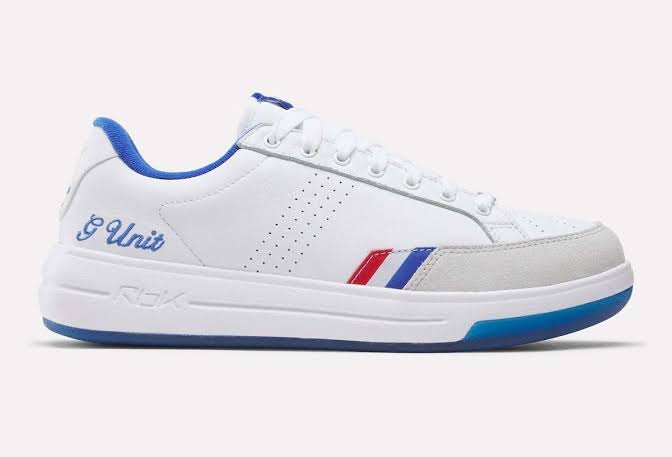
The upper is predominantly white leather, with light grey suede wrapping the toe and extending back along the lower side panels. That suede-to-leather transition is the detail most modern retros get wrong — brands tend to flatten it into a single material for cost. It survives here.
The accents are red, white and blue, clustered around the forefoot and the heel. A tri-colour lace piece sits above a perforated toe box. The heel tab carries the same three-colour treatment.
The branding is where the shoe earns its era. “G-Unit” is embroidered in blue script on the lateral heel. A silver lace dubrae carries G-6 branding. Reebok appears on the tongue label, the heel tab, the midsole and the outsole, with an RBK logo on the lateral side of the sole.
The interior and outsole are royal blue — lining, tongue label, and a translucent outsole that reads as period-correct rather than retro-pastiche.
Spec Snapshot
| Component | 2026 Retro |
|---|---|
| Upper | White leather with light grey suede toe and lower panels |
| Accents | Red, white and blue at forefoot and heel |
| Heel branding | Blue “G-Unit” script embroidery, lateral side |
| Lace hardware | Silver G-6 dubrae |
| Lining / tongue | Royal blue |
| Outsole | White sole unit with translucent royal blue, RBK lateral logo |
| Silhouette | Heavy low-top, early-2000s basketball-derived |
| Build era cues | Perforated toe box, layered panelling, oversized logo placement |
The one thing worth setting expectations on: this is a bulky shoe by 2026 standards. The G6 sits closer to a basketball trainer than a court sneaker. If your mental reference point is a Sambas-and-tapered-trousers silhouette, this will feel enormous on foot. That is the point, and it’s also the reason it works with the wide-leg denim that’s currently everywhere.
The Backstory: How a Rapper Outsold Jay-Z Six to One
The G6 launched in 2003, alongside Get Rich or Die Tryin’. That timing is not incidental — it’s the entire mechanism. 50 Cent was, for roughly eighteen months, the most inescapable figure in popular music, and Reebok attached a shoe to that moment with unusual precision.
He was among the very first rappers with a genuine signature sneaker line, not a co-branded capsule. That distinction matters. Before the G6, artists endorsed shoes. After it, artists had lines.
The Reebok Bidding-War Origin Story
The most-repeated piece of context comes from a 2012 radio interview, where 50 Cent explained that Reebok’s move into artist footwear — his line and Jay-Z’s S. Carter alongside it — was a direct consequence of losing the bidding war for LeBron James to Nike. Unable to sign the athlete of the generation, Reebok signed the culture instead.
It worked. 50 Cent has claimed the G-Unit line outsold the S. Carter roughly six to one, at a point when Jay-Z’s shoe held the record as Reebok’s fastest-selling sneaker to date. He has also put figures on the partnership: around $80 million at its peak, and more than 3.8 million pairs sold.
Two honest caveats on those numbers, because this is where sneaker writing usually goes soft. They are the artist’s own figures, repeated in interviews rather than confirmed in Reebok’s accounts. And the $80 million is frequently misreported as G6-specific revenue when it refers to the entire Reebok partnership, apparel and all. Treat them as directionally true and precisely unverified.
What isn’t in dispute is the cultural weight. The G6 is one of the load-bearing artefacts of the moment hip-hop stopped being a reference point for sneaker design and became a driver of it. Every artist signature line that followed — and there have been hundreds — is standing on this shoe.
Beyond the G6: The Full G-Unit Reebok Family
If you only remember one G-Unit Reebok, it’s the G6. But the line was broader than most people recall, and the vintage market reflects that.
| Model | What It Was |
|---|---|
| G6 | The flagship low-top. The one returning in 2026. |
| G6 II / G6 III | Successor iterations with revised panelling and new colour treatments |
| G6 Runner | A lighter, runner-derived take on the G6 language |
| G XT | Mid-cut trainer, often in suede — quietly the connoisseur’s pick |
| G-Unit Ladies | Women’s-specific build, most commonly in white leather with royal accents |
| G-Unit Boot | The tan-and-white lug-sole work boot — the one Timothée Chalamet resurfaced in 2025 |
That last entry deserves attention, because it’s arguably the reason this retro exists at all.
In December 2025, during the Marty Supreme promotional run, Chalamet was photographed leaving BBC Radio Studios in London wearing a vintage pair of tan-and-white G-Unit boots with metallic accents and a lug sole. The image travelled. A silhouette that had been dormant for two decades was suddenly being screenshotted by people who were toddlers when it released — the same mechanism we unpacked in our look at how luxury sneakers conquered high fashion, where a single celebrity styling choice can reprice an entire archive.
Note: the 2026 retro is the G6 low-top, not the boot. If the Chalamet pair is what you’re after, you’re still shopping the vintage market.
Why Reebok Is Doing This Now
Three forces are stacking, and Reebok is reading them correctly.
1. The archive is the asset. Reebok’s most valuable inventory is its own history. The brand recently brought back the BBC Ice Cream Board Flip, and the pattern is consistent: mine the collaborative back catalogue rather than trying to out-innovate brands with far larger R&D budgets. It’s a sound strategy for a brand rebuilding market position.
2. Y2K has hit the sweet spot. Nostalgia cycles run roughly twenty to twenty-five years. The G6 is landing at exactly the moment when the people who wanted it at fourteen have disposable income, and their kids find the aesthetic genuinely new.
3. The music-footwear pipeline is active again. Reebok’s recent signings signal renewed appetite for artist-driven footwear — a category the G6 helped invent. Bringing back the origin product while rebuilding that roster is coherent brand-building, not just a nostalgia cash-in.
There is a risk, and it’s worth naming. Sneaker culture in 2026 is a different market. A significant share of the buying audience has no relationship with Get Rich or Die Tryin’ and no memory of the original run. Nostalgia converts reliably among people who lived through it; among everyone else, the shoe has to work on design alone. The G6 might — the proportions are genuinely on-trend — but it won’t get a cultural discount.
How to Buy the G6 on August 20
Confirmed channels: Reebok’s own site and JD Sports, plus select retailers online and in-store.
Practical guidance for launch day:
- Set up accounts and payment in advance. Saved cards, correct billing address, confirmed email. Most launch-day losses are admin failures, not bot failures.
- Expect a general release, not a raffle. At $130 with broad retailer distribution, this is unlikely to be a raffle-gated drop. Volume should be reasonable.
- Watch for an early launch. With activations rumoured around New York, an in-person or early-access release before August 20 is plausible.
- Don’t panic-buy resale on day one. General releases almost always restock or sit. Resale premiums on launch day for a widely distributed shoe are the most avoidable money in sneakers.
For a wider view of what else is landing this season, our July 2026 drop guide tracks the full release calendar.
Buying G Unit Sneakers in India
Straight answer: there is no confirmed India release date. Reebok’s India business operates under an Aditya Birla licensing arrangement rather than direct global distribution, which means India-specific launches for niche retro programmes are decided locally and often lag the US calendar — sometimes by months, sometimes permanently.
Here’s how to approach it.
Route 1 — Wait for Reebok India. If the G6 gets a domestic launch, expect it through Reebok India’s own channels and the usual large-format partners. Indicative pricing, if it lands, would likely sit somewhere in the ₹9,000–₹13,000 band based on how comparable Reebok Classics are positioned domestically. That is a ballpark, not a quoted price.
Route 2 — Import platforms. Novelship, GOAT and similar marketplaces ship to India. Landed cost after duty and shipping realistically pushes a $130 shoe into the ₹15,000–₹20,000 range. Verify the total at checkout before committing — customs charges are frequently the difference between a good deal and a bad one.
Route 3 — Domestic sneaker retail. Stores like VegNonVeg, Superkicks and Mainstreet Marketplace stock selected international releases. None have announced this pair. If the G6 performs in the US, a limited India allocation becomes more likely, not less — but treat it as possible rather than expected.
A Counterfeit Warning You Should Actually Read
The G6 is a high-risk counterfeit target, for a specific reason: there are two decades of vintage pairs circulating, which gives sellers cover to explain away inconsistencies as “aging” or “old stock.”
Check these:
- The heel embroidery. Fakes routinely get the G-Unit script weight and spacing wrong. Compare against official imagery, not other listings.
- The suede toe. Counterfeits often substitute synthetic nubuck. It photographs similarly and feels immediately wrong.
- The lace dubrae. The silver G-6 hardware is a common failure point — check finish quality and engraving depth.
- Box and style code. The 2026 retro carries style code 100289469. A mismatch on a “new” pair is disqualifying.
If you’re buying vintage rather than the retro, insist on authentication. Marketplaces with verification programmes cost more for a reason, and the growing infrastructure around authenticated resale exists precisely because this category is hard to police.
Vintage vs Retro: The Resale Reality
Before the retro was announced, original-run G6 pairs were commanding real money. Deadstock and near-deadstock examples have appeared on general marketplaces anywhere from around $125 for worn pairs up to $400–$500 for clean sizes, with outlier asks running past $1,000 for rare colourways. Curated resale platforms have listed OG G6 variants with asking prices in the high hundreds.
Two things to understand about those numbers.
Asking prices are not sale prices. Thin-volume vintage categories produce wildly optimistic listings that sit unsold for months. Treat high asks as sentiment, not market value.
A retro compresses vintage pricing — but not evenly. When a $130 retro of the exact colourway hits shelves, demand for beat-up 2003 pairs of that same colourway generally softens. Genuinely rare variants — team colourways, the boot, unusual materials — often hold or climb, because the retro proves demand without satisfying it.
The practical read: if you want the white/royal G6 to wear, buy the retro. Twenty-three-year-old leather and polyurethane is structurally unreliable regardless of how good it looks — midsoles from that era crumble, and a pair that looks pristine can fail on first wear. If you want the white/royal G6 as an artefact, the OG still carries the provenance, and you should expect to pay for it while accepting it may never be worn.
Sizing, Styling and Who Should Skip This
Sizing
Reebok has not published fit guidance for the retro. Historically, the G6 ran roughly true to size with a generous width, consistent with early-2000s basketball-derived lasts. Narrow feet may find volume in the forefoot. If you’re between sizes, going down is the safer bet given the build.
Because the retro is arriving in men’s sizing only at launch, anyone below a men’s US 7 will need to wait and see whether a broader size run follows. Worth flagging given the original line included a dedicated women’s model.
Styling
The G6 is a wide-leg shoe. It looks correct under baggy denim, loose cargos and relaxed track pants — the silhouette it was designed alongside. It looks unbalanced under anything tapered.
The white/grey/red/blue palette is busier than it appears in product shots. Keep the rest of the outfit quiet. And factor in monsoon reality if you’re wearing these in India: white leather with suede panelling is not a rainy-season shoe, and our sneaker care archive covers suede protection properly.
Pros and Cons
| Pros | Cons |
|---|---|
| Faithful 1:1 retro — no unnecessary redesign | Bulky proportions won’t suit every wardrobe |
| $130 is fair for a leather-and-suede build | Men’s sizing only at launch |
| Genuine cultural significance, not manufactured hype | Single colourway confirmed |
| Broad retailer distribution should mean fair access | No India release confirmed |
| Palette is busy and hard to style casually |
Who Should Buy
- Anyone who wanted these in 2003 and never got them
- Y2K-leaning dressers already running wide-leg silhouettes
- Collectors building a hip-hop footwear archive
- Anyone who prefers wearable retros to fragile vintage
Who Should Skip
- Minimalists — this shoe is loud by construction
- Anyone whose wardrobe is built on tapered fits
- Buyers hoping for immediate resale profit; a general release at $130 with broad distribution is not a flip
- Anyone needing performance footwear. This is a lifestyle shoe with 2003 cushioning technology
The Editorial Take
The most interesting thing about this release is what Reebok didn’t do.
There was an obvious commercial path here: modernise the G6, drop it in tonal colourways, attach a contemporary artist, chase a collaboration cycle. Reebok took none of it. The shoe arrives as the shoe was, priced sensibly, distributed widely, with no manufactured scarcity.
That’s a bet on the object rather than the marketing around it, and it’s an increasingly rare bet in a category that has spent a decade optimising for hype mechanics over product. Whether it pays off depends on something Reebok can’t control — whether a generation with no memory of 2003 finds this shoe good-looking on its own terms.
Our read: it will. Not because of 50 Cent, and not because of nostalgia, but because the proportions genuinely fit what people are wearing right now. The cultural history is a bonus, not the pitch.
Key Takeaways
- G Unit sneakers return on August 20, 2026 — the Reebok G-Unit G6, style code 100289469, at $130 in men’s sizing.
- It’s a genuine 1:1 retro of the 2003 white/royal colorway, with no design updates.
- Tony Yayo leaked it in May 2026 on The Real Report podcast, months before Reebok confirmed anything.
- The original line generated a claimed $80 million across the wider Reebok partnership, with 50 Cent stating it outsold Jay-Z’s S. Carter six to one — his figures, not verified brand accounts.
- Y2K nostalgia and a Chalamet sighting did the cultural groundwork; official images did the rest.
- No India release is confirmed. Import routes land around ₹15,000–₹20,000; a domestic launch, if it happens, would likely sit near ₹9,000–₹13,000.
- Counterfeit risk is high because vintage pairs give sellers cover for inconsistencies. Check heel embroidery, suede quality, dubrae finish and style code.
- Buy the retro to wear it. Buy vintage only to collect it.
The return of the g unit sneakers is being framed as a nostalgia play, and that framing undersells it. Nostalgia explains the attention; it doesn’t explain the decision to leave the shoe alone.
Reebok has put a twenty-three-year-old design back on shelves at a fair price, in wide distribution, with the original colour blocking intact and no attempt to launder it through a contemporary collaborator. In a market that has spent years teaching buyers to expect scarcity theatre, that’s close to a statement of confidence.
August 20 will tell us whether the confidence was warranted. Our guess is that plenty of people who couldn’t get these in 2003 have been waiting a long time to correct that — and a decent number of people who’ve never heard Get Rich or Die Tryin’ are about to buy them anyway, purely because they look right with the jeans they’re already wearing.
Both are valid reasons. Only one of them was ever the plan.